
Expat Health Insurance in Thailand: O-A THB 3,000,000
The O-A visa needs health insurance of USD 100,000 or THB 3,000,000. The O-X needs a Thai policy with THB 40,000 outpatient and THB 400,000 inpatient cover. The LTR asks for a USD 50,000 policy, or an alternative. The DTV document list names no insurance. For the retirement extension, only O-A holders must have health insurance.
On this page
- Health insurance by visa type
- Who each visa is for
- O-A: USD 100,000 or THB 3,000,000
- O-X: a Thai policy with outpatient and inpatient limits
- LTR: a policy, social security or a deposit
- DTV and the Non-O retirement extension
- Insurance for the visa is not hospital billing
- What the insurance certificate is
- Social security for employees
- Common questions
The O-A visa needs health insurance of USD 100,000 or THB 3,000,000. The O-X needs a different pair of numbers: THB 40,000 outpatient and THB 400,000 inpatient. Mixing them up is the common mistake, so the table comes first.
Health insurance by visa type
| Visa | Insurer | Sum insured |
|---|---|---|
| O-A (retirement long stay) | Thai or foreign insurer | USD 100,000 or THB 3,000,000 |
| O-X (long stay) | Insurer in Thailand | THB 40,000 outpatient, THB 400,000 inpatient |
| LTR | Policy, or social security, or deposit | USD 50,000 policy, or USD 100,000 deposit |
| DTV | None on the London list | None listed |
| Non-O retirement extension | Only O-A holders must hold cover | None for Non-O |
Who each visa is for
The insurance rule travels with the visa conditions, so check you qualify first.
- O-A: the applicant must be at least 50 years of age on the day of applying. Financial evidence is monthly income of at least THB 65,000 or a balance of THB 800,000.
- O-X: a fixed deposit of at least THB 3,000,000, or at least THB 1,800,000 with income of at least THB 1,200,000 per year. Applicants hold a passport from one of 14 listed countries.
- LTR: the health requirement is the policy, social security or deposit in the table.
- DTV: financial evidence of £12,000 (500,000 THB) and a document list with no insurance line.
The sums are the minimums on the lists. The embassy handling your application sets the exact document list, so read its page before you buy a policy.
O-A: USD 100,000 or THB 3,000,000
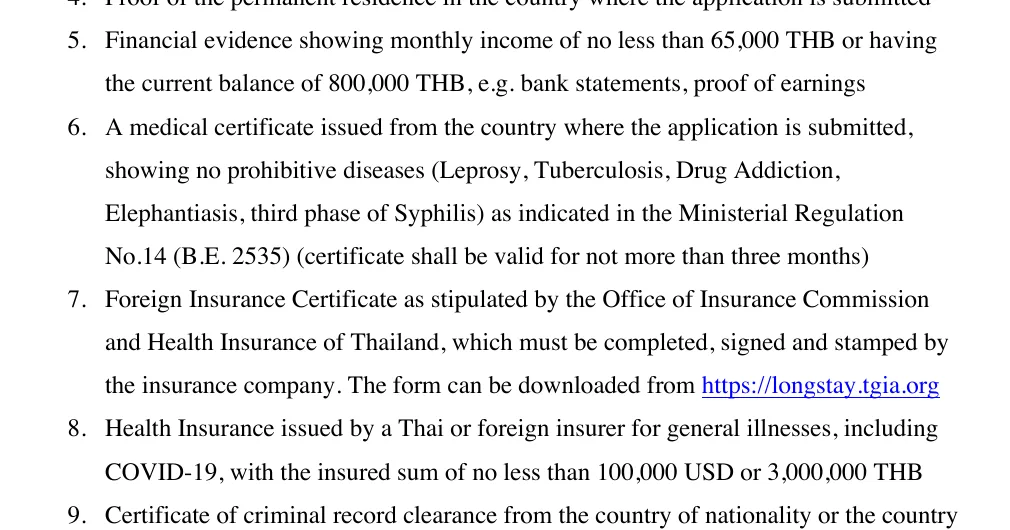
The embassy list for the O-A asks for health insurance for general illnesses, including COVID-19, with an insured sum of at least USD 100,000 or THB 3,000,000. The same figure applies for the whole period of stay.
The Immigration Bureau order repeats it for holders of the O-A: cover of at least USD 100,000 or THB 3,000,000 for the entire stay in the Kingdom.
Why an older figure still circulates
Some embassy texts still show older O-A wording with an inpatient cover of THB 400,000 per policy year. The O-X list carries that inpatient figure today. For the O-A, use the USD 100,000 or THB 3,000,000 figure.
O-X: a Thai policy with outpatient and inpatient limits
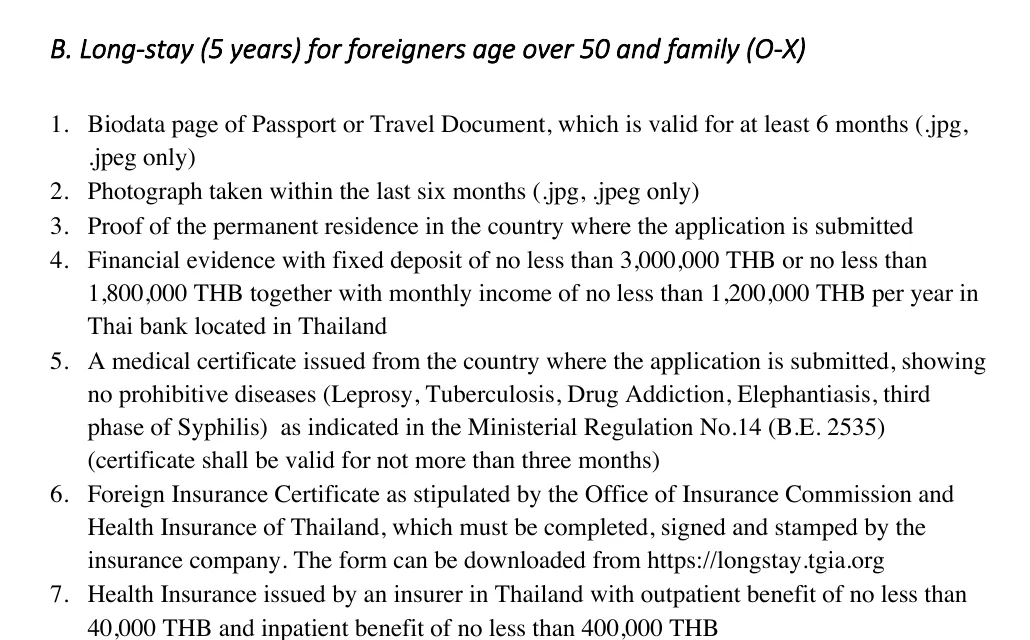
The O-X list asks for health insurance issued by an insurer in Thailand. Outpatient benefit must be at least THB 40,000 and inpatient benefit at least THB 400,000. The same pair applies to the O-X.
The limits are per policy year. Each applicant, including spouse and children, must have their own Health Insurance Certificate at the visa application.
Keep the policy in force. An O-X holder must hold the Thai policy throughout the granted period, and the visa is withdrawn if that requirement fails.
LTR: a policy, social security or a deposit
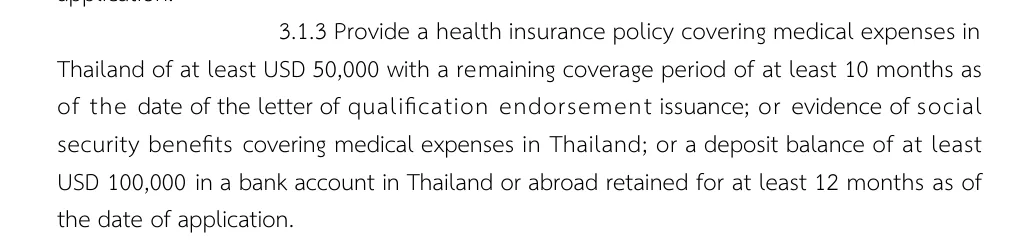
Each LTR category lets you meet the health requirement in one of three ways:
- a policy covering medical expenses in Thailand of at least USD 50,000, with at least 10 months of cover left on the endorsement date
- evidence of social security benefits covering medical expenses in Thailand
- a deposit balance of at least USD 100,000 held at least 12 months
Dependants have a similar choice. The deposit alternative for a dependant is an additional USD 25,000 per person held 12 months.
DTV and the Non-O retirement extension
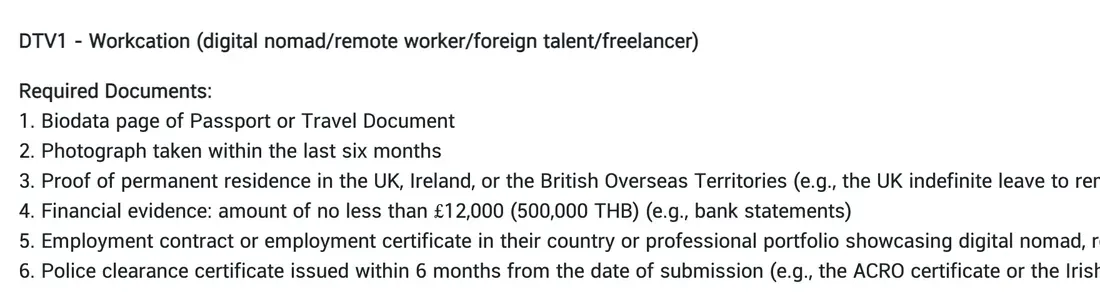
The London embassy’s DTV workcation list names a passport page, photo, proof of residence, financial evidence of £12,000 (500,000 THB), proof of work and a police clearance. Insurance is not on it.
For a retirement extension, the Immigration handbook says only holders of an O-A visa must have health insurance. The handbook names no insurance rule for a Non-O holder.
Spouses and children on a DTV
The DTV3 list for a spouse or child under 20 names the passport page, a photo and financial evidence of £12,000 (500,000 THB). It adds a police clearance and the DTV visa of the holder. Insurance is not on it.
Insurance for the visa is not hospital billing
A policy that meets the visa sum does not replace payment at the counter. UK government advice is that all hospitals require a guarantee of payment before treating patients. Whether your insurer bills the hospital directly depends on the policy, so read its claim terms before you rely on it.
What the insurance certificate is
Both long-stay visas call for a Foreign Insurance Certificate as stipulated by the Office of Insurance Commission. The insurance company completes, signs and stamps it, and the form can be downloaded from longstay.tgia.org.
At the O-A stage the certificate is presented to immigration. For a non-Thai policy, an authorised person of the insurance company or public organisation signs the form.
Participating insurance companies are listed on that site, with a certificate download for overseas policies. This page names no insurer.
Social security for employees
Foreign employees can be registered with the Social Security Office. Employers register employees as insured persons within 30 days of starting work.
| Item | Rule |
|---|---|
| Section 33 contribution | Paid monthly by employers and Section 33 insured persons |
| Wage base | THB 1,650 to THB 15,000 a month |
| Registration | Within 30 days of starting work |
| Foreign insured person | Copy of work permit and passport |
Foreign workers insured under Section 33 have the same medical treatment rights as Thai people, according to a Labour Minister statement of 12 March 2025.

Next, see English-speaking hospitals in Bangkok and vaccinations for Thailand.
Not confirmed: DTV insurance at every embassy: only the London document list was read in full; confirm with the post you apply at. Whether your insurer's certificate form is accepted for the O-X: the O-X rule asks for an insurer in Thailand.
Common questions
How much health insurance does the O-A visa need?
The O-A list asks for health insurance of at least USD 100,000 or THB 3,000,000, from a Thai or foreign insurer, including COVID-19. Immigration Order 12/2568 states the same sum for the whole stay.
How much insurance does the O-X visa need?
The O-X list asks for a policy from an insurer in Thailand with outpatient benefit of at least THB 40,000 and inpatient benefit of at least THB 400,000. The sums are per policy year.
Why do older O-A texts show a THB 400,000 inpatient figure?
Some embassy texts still show the older O-A wording with an inpatient cover of THB 400,000 per policy year. The current O-A sum is USD 100,000 or THB 3,000,000.
Does the LTR visa need health insurance?
Every LTR category needs a policy of at least USD 50,000 with at least 10 months of cover left. Social security benefits, or a deposit of at least USD 100,000 held 12 months, also qualify.
Does the DTV need health insurance?
No insurance appears on the London embassy's DTV workcation document list. Financial evidence of £12,000 (500,000 THB) does appear there.
Does a retirement extension need insurance?
For the retirement extension, only holders of a Non-Immigrant O-A visa must have health insurance.
What is the insurance certificate for the O-A and O-X?
A Foreign Insurance Certificate stipulated by the Office of Insurance Commission is asked for, completed, signed and stamped by the insurance company.
Where do I download the certificate form?
The embassy lists point to longstay.tgia.org for the form. The association lists the participating companies and a certificate download for overseas policies.
Do work permit holders get Thai social security?
Employers register employees as insured persons within 30 days of starting work. For a foreign insured person the Social Security Office asks for a copy of the work permit and passport.
Read next
General health information checked against the sources listed above, not medical advice. Rules, vaccine schedules and prices change; see a doctor or the hospital before you act. See how guides are checked.
Spotted an error? Report it.