
Thailand Cash Declaration: USD 15,000 or THB 450,000
Declare to Thai Customs foreign banknotes or coins worth more than USD 15,000, or baht notes or coins worth more than THB 450,000, when you enter or leave. Baht, foreign currency and instruments that together exceed THB 450,000 also need a declaration. Failure carries a fine of up to THB 20,000, up to 3 years in prison, or both.
On this page
Two numbers decide it: USD 15,000 in foreign cash and THB 450,000 in baht. Go above either one, in or out of Thailand, and you declare to Customs. A mix of baht, foreign cash and instruments counts together against THB 450,000.
The thresholds
Foreign banknotes and coins above USD 15,000 or the equivalent must be declared, and so must baht above THB 450,000. The thresholds come from Ministry of Finance Notification No. 6.
| What you carry | Declare when it exceeds |
|---|---|
| Foreign banknotes and coins | USD 15,000 or the equivalent |
| Baht banknotes and coins | THB 450,000 |
| Instruments in baht | THB 450,000 |
| Instruments in foreign currency | USD 15,000 or the equivalent |
| Baht, foreign currency and instruments together | THB 450,000 |
Foreign currencies which are foreign currency notes or coins which their aggregate value exceeding US$15,000 or its equivalent at market rate
Notification of the Ministry of Finance, Exchange Control (No. 6), clause 1(2), Bank of Thailand translation
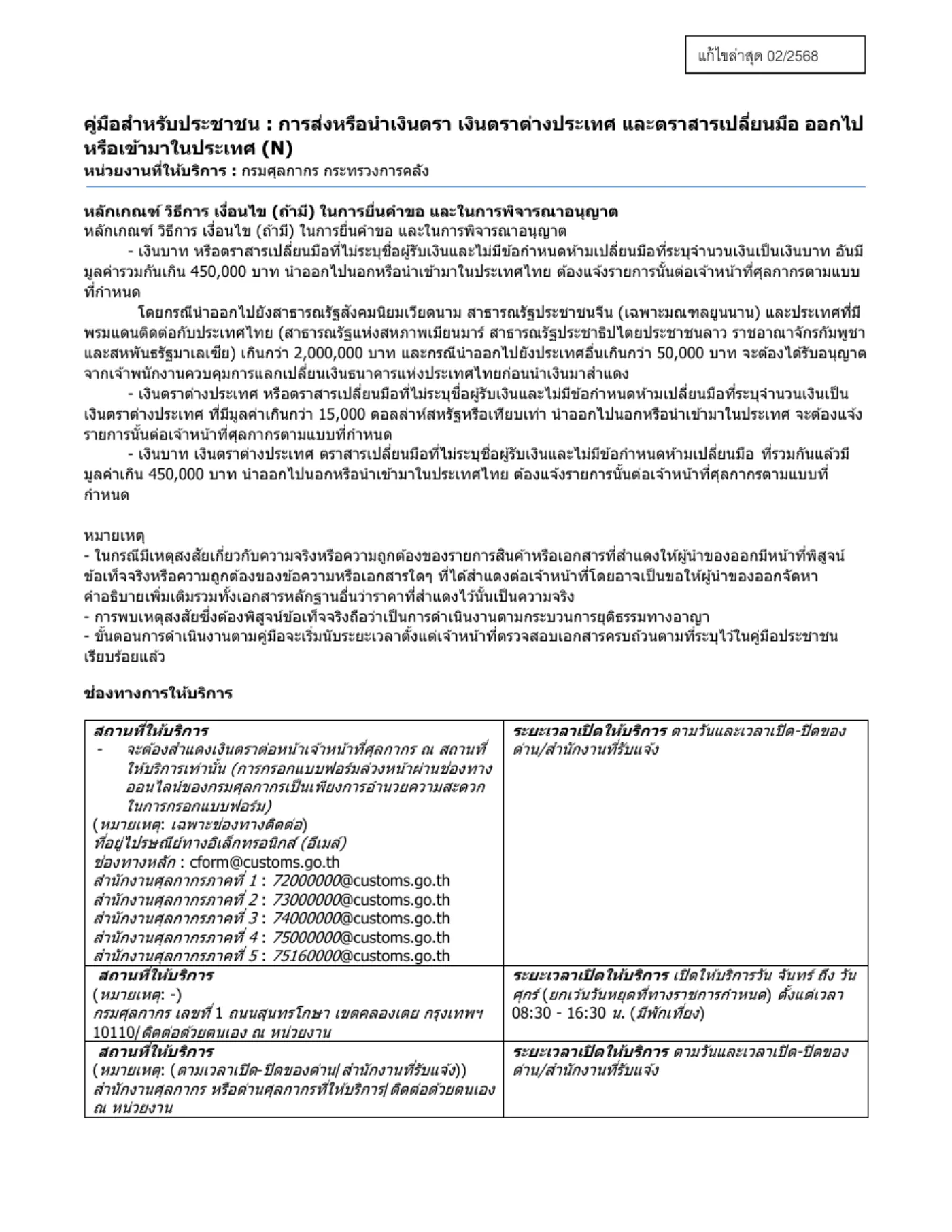
Negotiable instruments count only if the payee is not specified and there is no restriction on transfer. The Customs Department’s current manual repeats the thresholds. Any combination of currency, foreign currency or instruments above THB 450,000 must be declared while passing customs.
Bringing cash in and taking it out
You may bring banknotes into Thailand without an amount limit. Declaring starts above the thresholds. Taking cash out adds caps of its own.
| Item taken out | Cap |
|---|---|
| Foreign banknotes | The amount bought from authorised banks or money changers |
| Baht to bordering countries, Vietnam and China (Yunnan only) | THB 2 million |
| Baht to any other country | THB 50,000 |
Taking baht out above those caps needs permission from the Bank of Thailand exchange control officer before you declare. The declaration threshold and the take-out caps are separate rules.
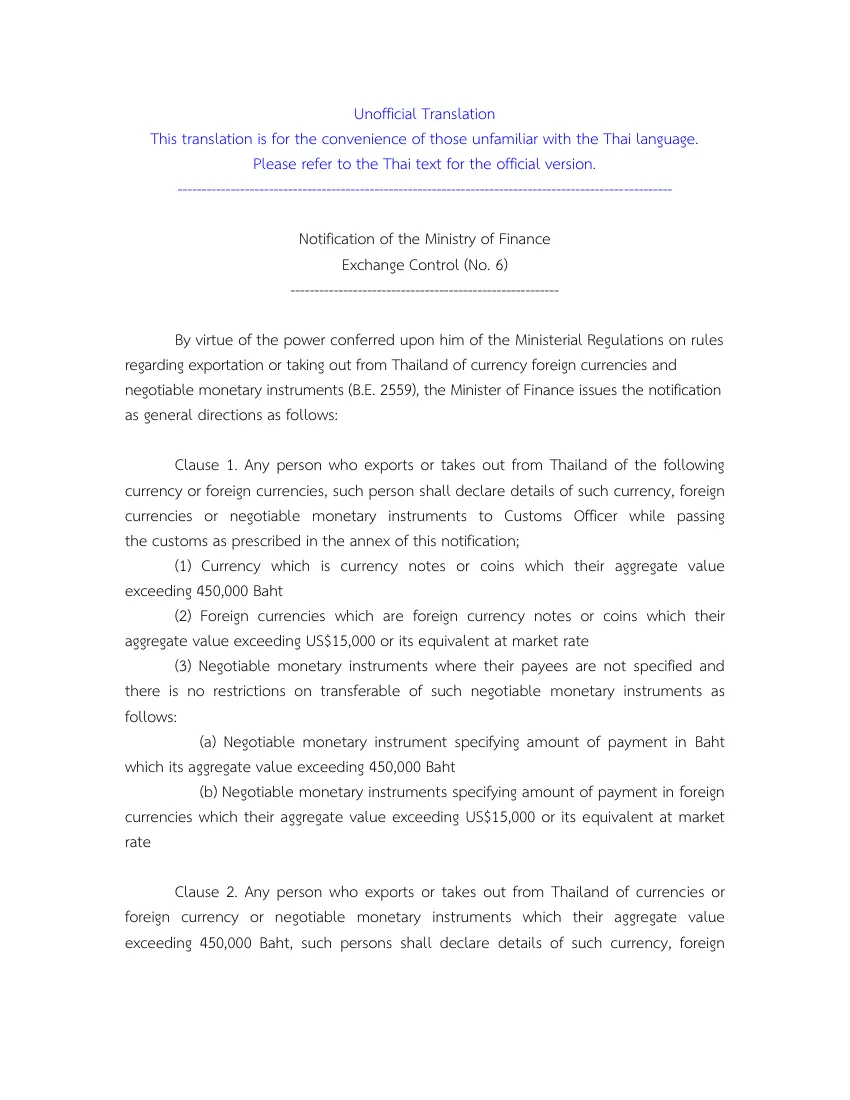
You declare to a Customs officer at customs, or to an immigration officer at the immigration or border checkpoint. Anyone who assists or is involved in an unlawful export or import falls under the same Customs rules.
How to declare, step by step
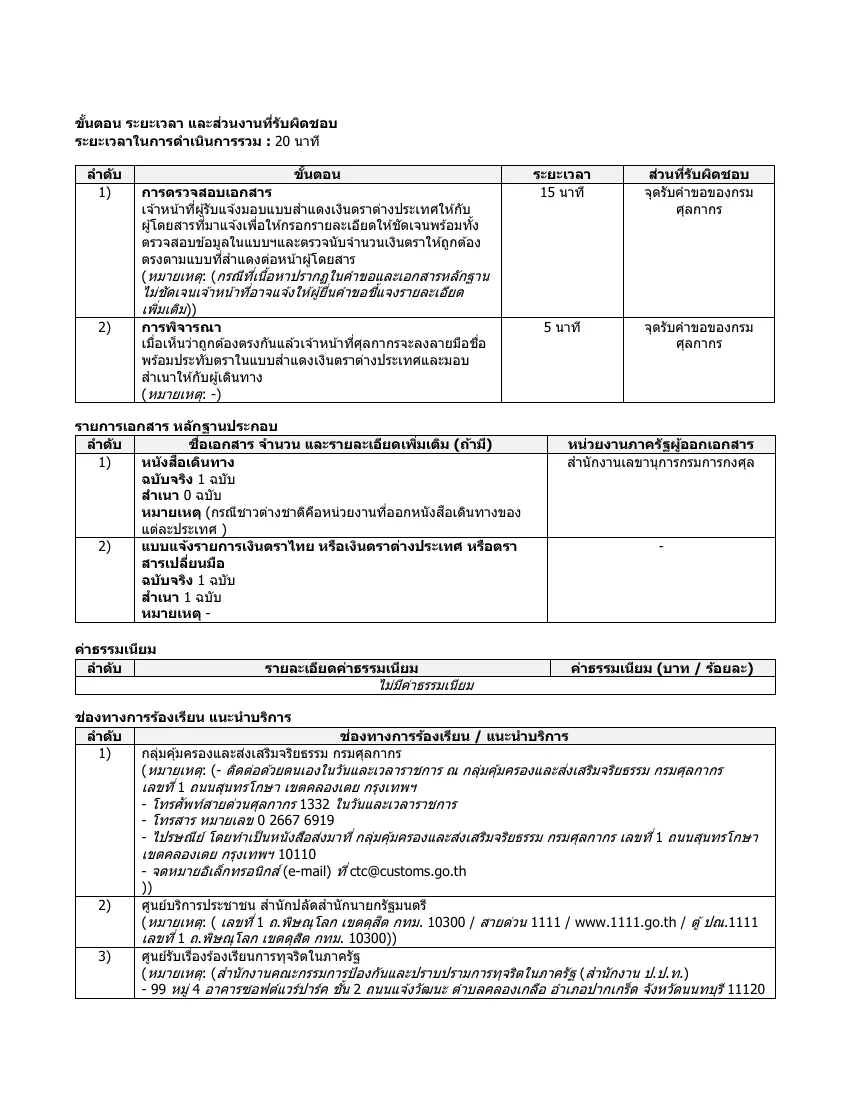
A Customs officer takes your declaration while you pass customs. You declare in person. Filling the form in online beforehand only helps you complete it.
- Go to the Customs officer at the checkpoint. Service follows the opening days and hours of that checkpoint or office.
- Take the form for Thai currency, foreign currency or negotiable instruments.
- Fill in the details clearly. The officer checks the data on the form and counts the money.
- Answer truthfully any question the officer asks about the information on the report.
- The officer stamps the form.
Count your cash before you reach the desk, because the officer counts the money against the details on your form. Declare while you pass customs, since that is when the duty applies. Declaring costs nothing.
The Customs manual gives 20 minutes as the total time. The Customs hotline is 1332 on official working days and hours. Customs passes the data to the Ministry of Finance and the Anti-Money Laundering Office.
Which rule says what
Four texts work together. Each does one job.
| Text | Job |
|---|---|
| Ministerial Regulations on taking currency out | Set the duty to declare to a Customs officer |
| Ministry of Finance Notification No. 6 | Sets the baht and foreign currency thresholds |
| Exchange Control Act, section 8 | Sets the penalty range |
| Exchange Control Act, section 8 bis | Treats currency as articles under Customs law |
The Ministerial Regulations were given on 22 December B.E. 2559. The Act’s section 6/1 was amended and published in the Government Gazette on 11 December B.E. 2559. Notification No. 6 was given on 8 February B.E. 2560. It comes into force from the day after its publication in the Government Gazette.
The Notification therefore predates the figures on older web pages. Customs and the Bank of Thailand both use it today.
What happens if you do not declare
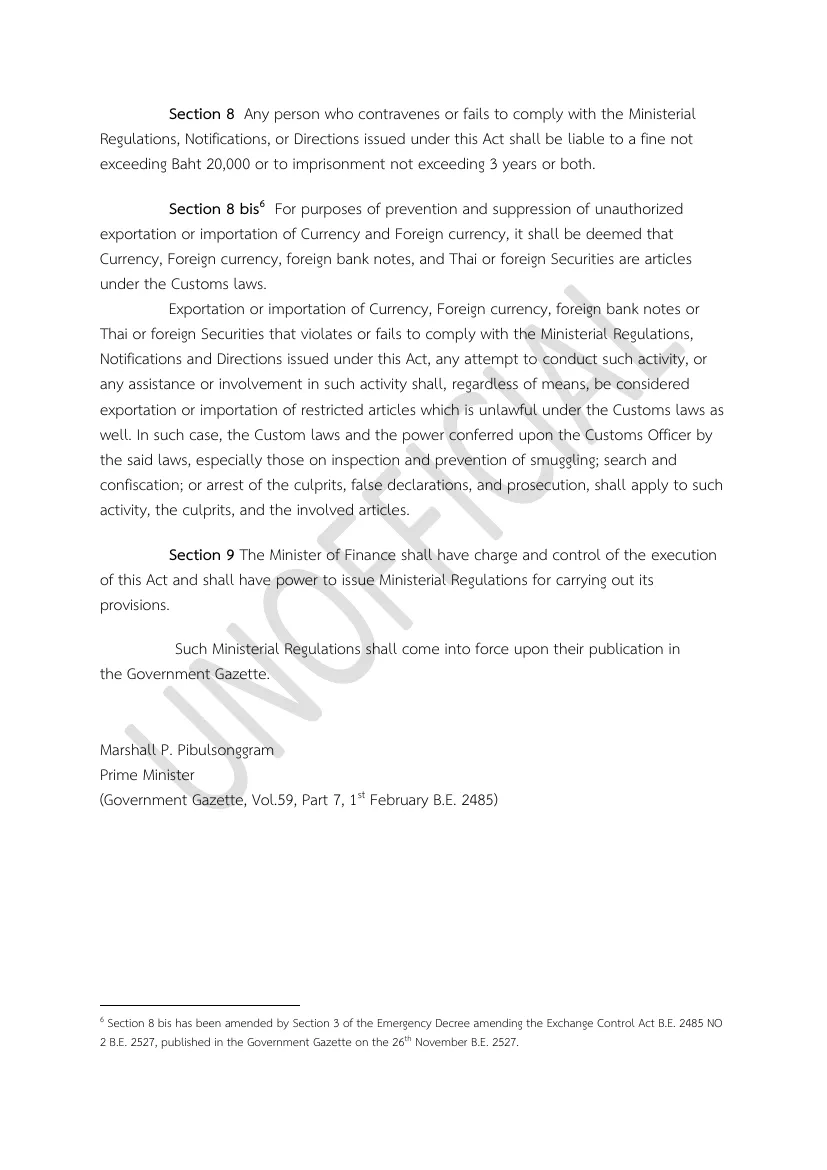
Breaking an exchange-control regulation or notification carries a fine of up to THB 20,000, up to 3 years in prison, or both.
Currency moved against the rules counts as an unlawful export or import of restricted articles under Customs law. Customs powers of search and confiscation, arrest, and prosecution for false declarations apply.
Quick answers by situation
| Situation | What applies |
|---|---|
| Arriving with foreign cash above the threshold | Declare to Customs |
| Arriving with any amount below the thresholds | No amount limit on bringing banknotes in |
| Leaving with foreign cash | Only up to the amount bought from banks or money changers |
| Leaving with baht for a neighbouring country | Up to THB 2 million, with a declaration above THB 450,000 |
| Leaving with baht for any other country | Up to THB 50,000 |
| Carrying baht, dollars and cheques together | The mixed total counts against THB 450,000 |
| Helping a friend carry their cash | Covered by the same Customs rules |
| Declaring at an immigration or border checkpoint | Declare to an immigration officer there |
Old figures and what banks ask later
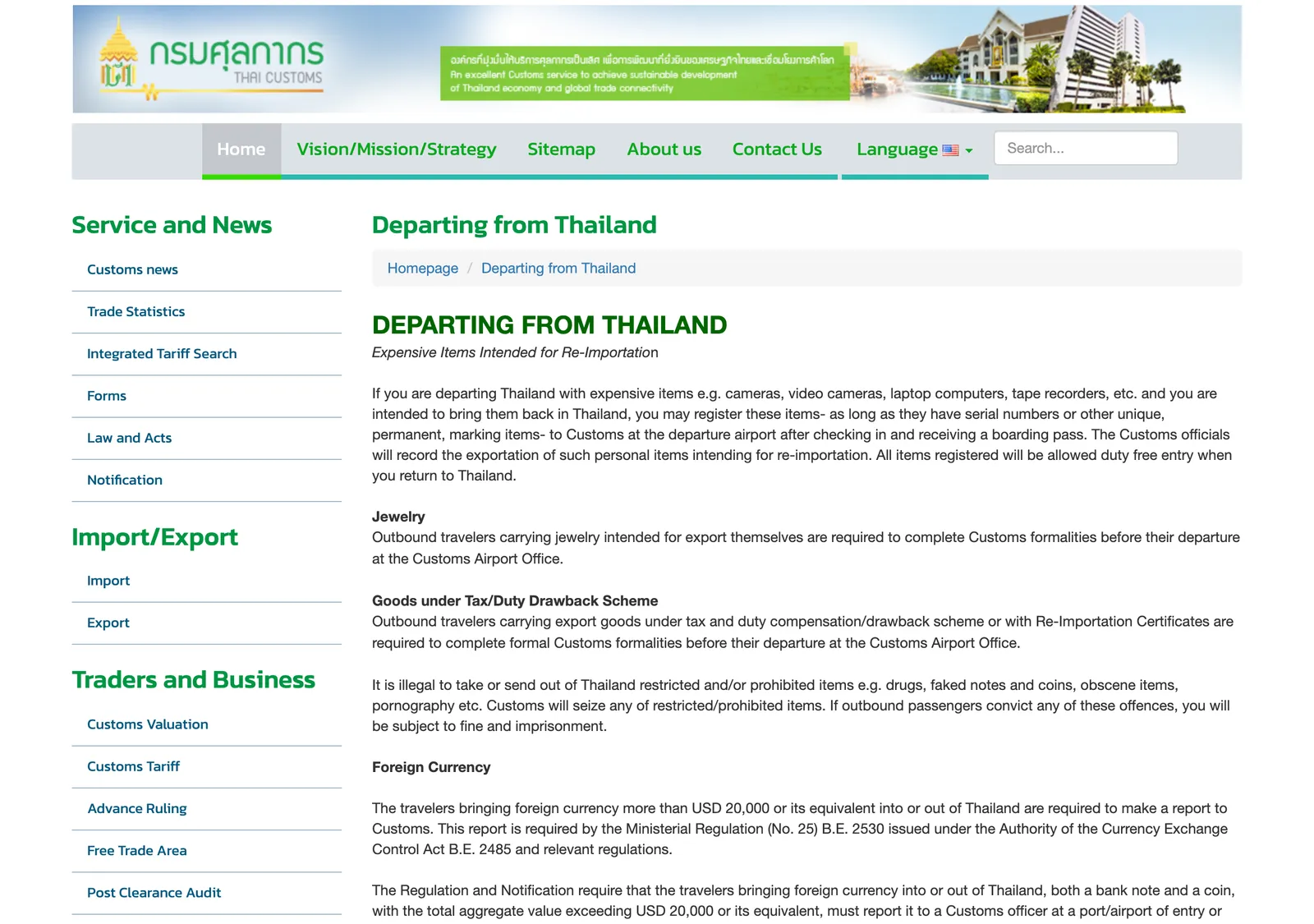
Guides that give USD 20,000 are out of date. That figure sits on a Customs page last updated on 29 February 2016, before the 2017 notice. Use USD 15,000.
Banks use the same figure. A bank accepts foreign banknotes from a customer up to USD 15,000 a day or the equivalent without asking for documents. Above that, it asks for documents showing the money was brought into the country, such as the Customs declaration.
Keep your stamped form if you bring in more than USD 15,000 and plan to change or deposit it.
Step by step
- Add up everything you carryCount foreign banknotes and coins, baht notes and coins, and negotiable instruments. Foreign cash above USD 15,000 or baht above THB 450,000 must be declared.
- Go to a Customs officerDeclare in person to a Customs officer while passing customs.
- Complete the formUse the form for Thai currency, foreign currency or negotiable instruments.
- Have it stampedThe officer checks the form and stamps it. Declaring is free.
Not confirmed: The Bank of Thailand page caps foreign banknotes taken out at the amount bought from banks or money changers. No Customs page repeats that cap, so the airport check is unknown. Keep your exchange receipts if you carry foreign cash out. Whether relatives travelling together may pool one declaration is not confirmed.
Common questions
Is the Thailand declaration limit USD 15,000?
Yes, USD 15,000 or the equivalent. A figure of USD 20,000 comes from a Customs page last updated on 29 February 2016.
Do I declare baht and dollars separately?
Each has its own line: foreign cash above USD 15,000 and baht above THB 450,000. A mix above THB 450,000 in total must also be declared.
Is there a limit on bringing cash into Thailand?
There is no amount limit on bringing banknotes in. Above the thresholds you still declare.
How much baht can I take out of Thailand?
Up to THB 2 million to bordering countries, Vietnam and Yunnan, and up to THB 50,000 to other countries. Above those caps you need Bank of Thailand permission first.
Does declaring cost anything, and how long does it take?
No fee. The Customs manual gives 20 minutes in total.
Do cheques count toward the limit?
Negotiable instruments count only if the payee is not specified and there is no restriction on transfer. Those in baht count above THB 450,000, and those in foreign currency above USD 15,000.
Can I declare to an immigration officer?
You declare to a Customs officer at customs, or to an immigration officer at the immigration or border checkpoint.
What happens if I do not declare?
A fine of up to THB 20,000, up to 3 years in prison, or both. Customs may search, confiscate and arrest.
Will my bank ask for the Customs form later?
Banks accept foreign banknotes up to USD 15,000 a day without documents. Above that they ask for documents showing the money was brought in, such as the Customs declaration.
Read next
General information checked against the sources listed above, not financial or tax advice for your situation. Rules and fees change; confirm with your bank, the Revenue Department or a licensed adviser before you act. See how guides are checked.
Spotted an error? Report it.
Comments (1)
Imaginary-Eye5478
Tourist denied entry over min cash rule A foreign tourist has warned travellers after being denied entry at Thailand's Don Mueang Airport for insufficient funds. Immigration officers enforced the regulation requiring visitors to prove they possess at least 20,000 baht upon arrival. The traveller claimed she was unaware of the rule and was refused permission to withdraw cash from an ATM. She expressed frustration at the lack of clear guidance and was told to attempt entry through a different airport. Thai authorities confirm that proof of financial means is a mandatory requirement, though enforcement remains discretionary. Tourists are advised to ensure they carry adequate funds or documentation to prevent border issues.