
Can Foreigners Buy a Condo in Thailand? The 49% Quota
Foreigners together may hold no more than 49% of the total unit area of a condominium building. The buyer shows foreign currency brought into Thailand, or withdrawn from a non-resident baht account or a foreign-currency account, for at least the unit price. Land is closed unless a treaty applies, and Thailand has made none since 1970.
On this page
The figure that decides a condo purchase is 49% of the total unit area of the building. The proof is foreign currency brought into Thailand for the full price. Land follows different rules.
The 49% quota
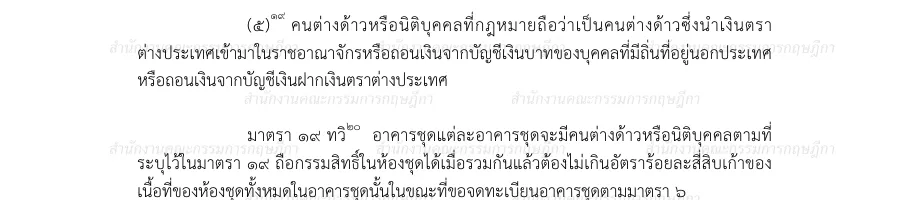
Foreigners and juristic persons treated as foreign may together hold ownership of units up to 49% of the total unit area of each condominium building. The share is measured against the total area at the time the condominium was applied to be registered.
ระบุไว้ในมาตรา ๑๙ ถือกรรมสิทธิ์ในห้องชุดได้เมื่อรวมกันแล้วต้องไม่เกินอัตราร้อยละสี่สิบเก้าของ
…as specified in section 19 may together hold ownership of units not exceeding forty-nine percent of ….
Condominium Act B.E. 2522, section 19 bis
On a transfer to a foreigner, the person transferring tells the official the names of the foreign owners and the share of unit area they already hold. The official registers the transfer when the papers are correct and the foreign share stays within the rate set in section 19 bis.
Which foreigners qualify
A foreigner permitted to reside in Thailand under the immigration law may hold a unit. The transferee shows proof of that permission at the Land Office. A second route runs through the money.
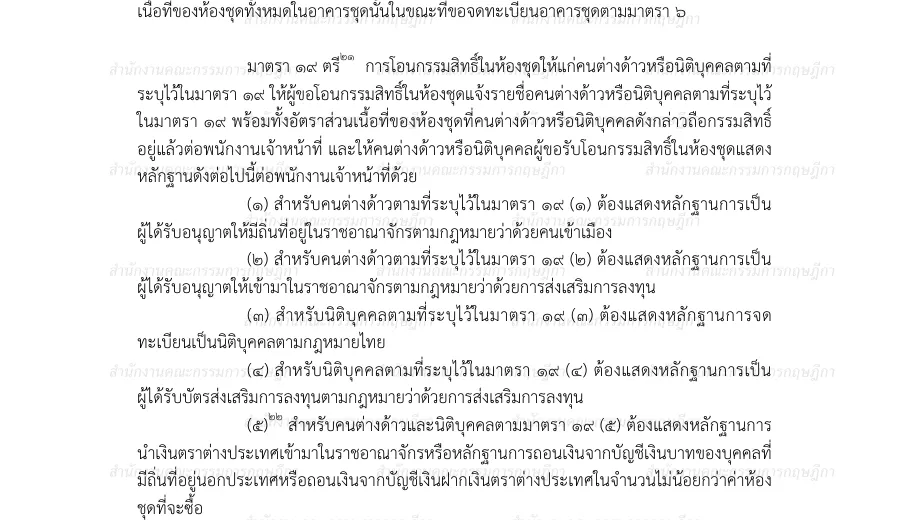
A foreigner or a juristic person treated as foreign may hold a unit. The route is bringing foreign currency into Thailand, or withdrawing from a baht account of a person resident abroad or a foreign-currency deposit account.
หรือถอนเงินจากบัญชีเงินฝากเงินตราต่างประเทศในจํานวนไม่น้อยกว่าค่าห้องชุดที่จะซื้อ
…or withdrawal from a foreign-currency deposit account, in an amount not less than the price of the unit to be bought.
Condominium Act B.E. 2522, section 19 ter (5)
Proof of the foreign money
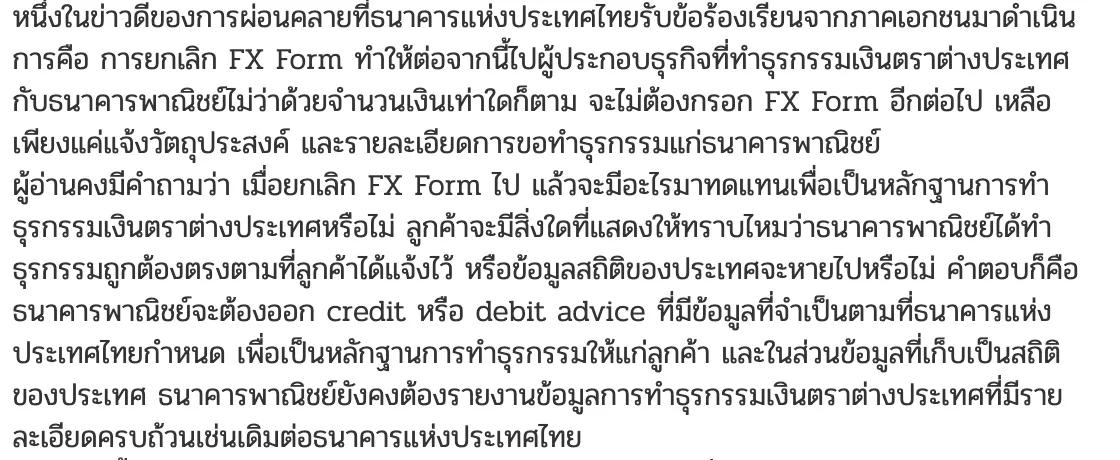
The foreign-currency evidence must be for an amount not less than the price of the unit.
The Bank of Thailand abolished the FX Form in 2017, so customers no longer fill it in for foreign-currency transactions with banks, whatever the amount. In its place the bank issues a credit or debit advice with the data the Bank of Thailand requires. Keep that advice for the Land Office.
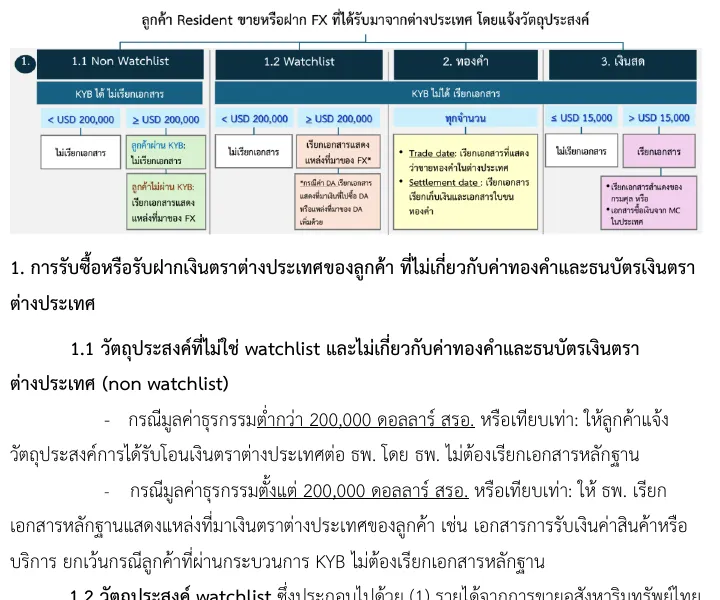
What the bank asks on the way in
Below USD 200,000 you state the purpose and the bank asks for no documents. At USD 200,000 or more the bank asks for documents showing the source of the foreign currency.
The transfer side, with fees, is on the send money to Thailand page.
Fees and taxes at the Land Office
The Land Office charges 2% of the appraised value, minimum THB 20, to register a transfer of a condominium unit. A seller who sells within five years pays specific business tax.
| Item | Rate | Base |
|---|---|---|
| Registration fee on a transfer | 2%, minimum THB 20 | Appraised value |
| Specific business tax, paid by the seller | 3.3% | Higher of appraised value or sale price |
| Stamp duty | THB 1 per THB 200 | Payment amount |
A sale within five years of acquiring the property attracts specific business tax. A sale registered more than five years after the seller acquired it is outside that tax. Stamp duty is not charged where the person receiving the payment pays specific business tax.
A worked example
Take a price of three million baht and an appraised value of three million baht. The figures below are estimates, not a quote.
| Charge | Estimate |
|---|---|
| Registration fee at 2% | THB 60,000 |
| Stamp duty, where no specific business tax is paid | THB 15,000 |
| Specific business tax at 3.3% | THB 99,000 |
Other sellers and the no-debt certificate
A developer selling a unit as the registrant of the condominium is subject to specific business tax. When a company or juristic partnership sells, income tax is withheld at 1% of the higher of the sale price or the appraised value. A separate withholding rule covers an individual seller, with years held counted to a maximum of ten.
The no-debt certificate
The officer registers rights and juristic acts over a unit only when it is free of the debts under section 18, shown by a certificate from the condominium juristic person. The manager must issue the certificate to the unit owner.
Leasehold instead of ownership
The Land Office does not register a lease longer than 30 years, and a longer lease is cut to 30 years. A lease of more than 3 years must be in writing and registered with the competent official.
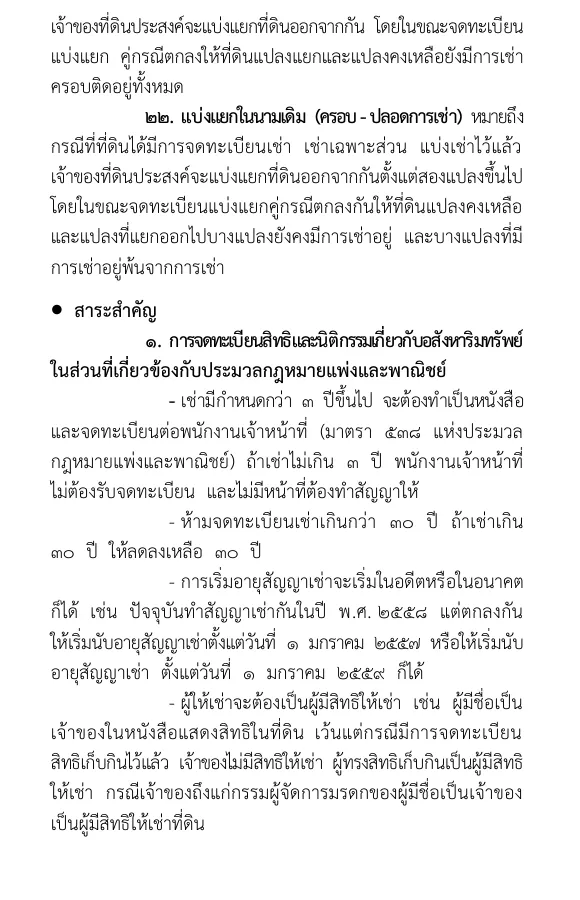
The manual puts this among its key points on rights and acts over immovable property under the Civil and Commercial Code. A separate Act on leases of immovable property for commerce and industry covers leases of more than 30 and up to 50 years.
The registration fee for a lease is 1%, charged on the rent over the lease term, on key money, or on both together.
Land stays closed
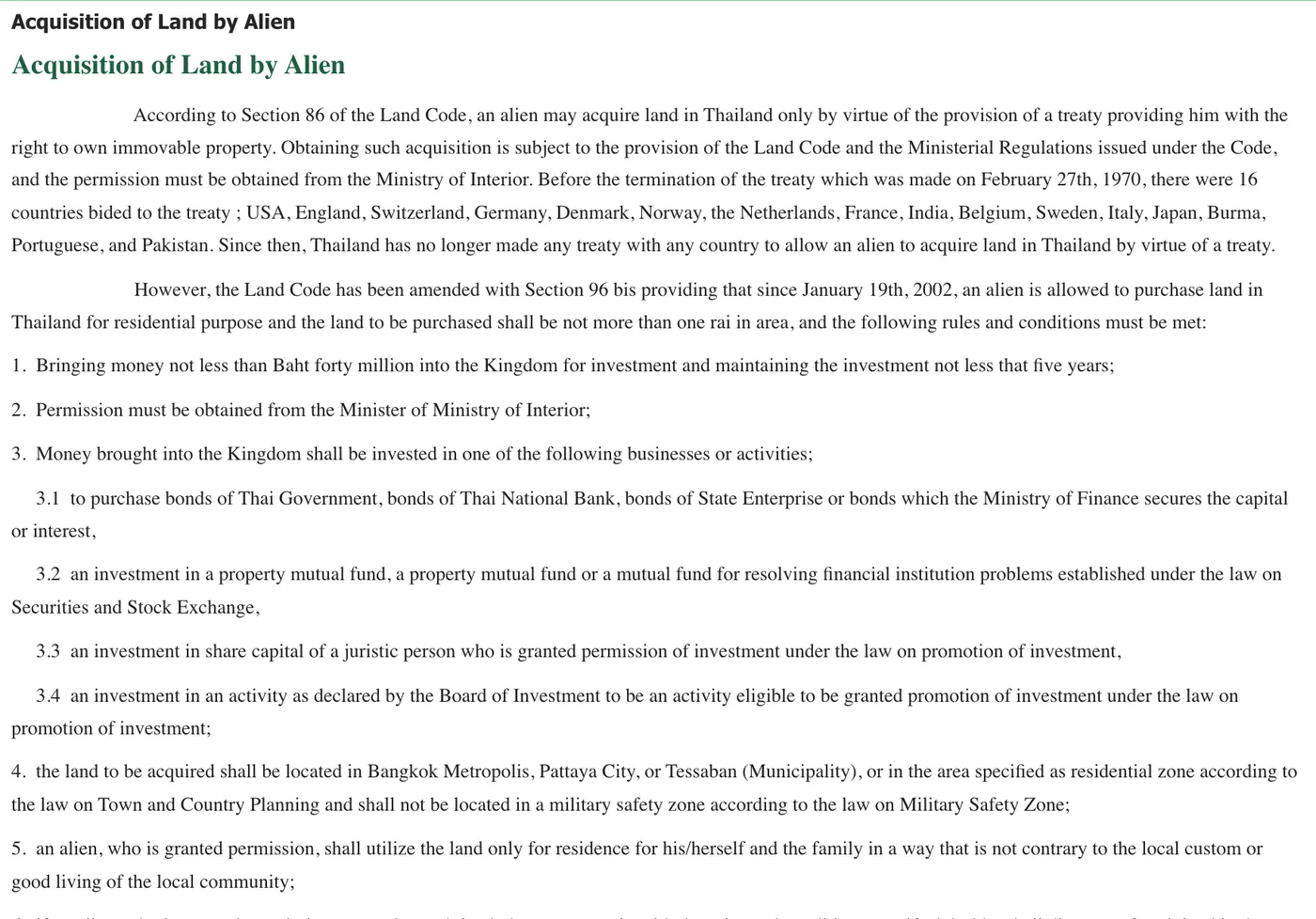
A foreigner may acquire land in Thailand only under a treaty that gives the right to own immovable property. Thailand has made no such treaty with any country since the 1970 treaty ended.
Section 96 bis of the Land Code is one route. It allows up to one rai for residence. It needs at least THB 40 million brought in for investment and kept invested for at least five years. The Interior Minister must give permission.
A foreigner may also acquire land by inheritance as a statutory heir, within the legal area limits. When a Thai spouse buys land, the foreign spouse must give a written confirmation that the money is the Thai spouse’s separate property.
At the Land Office
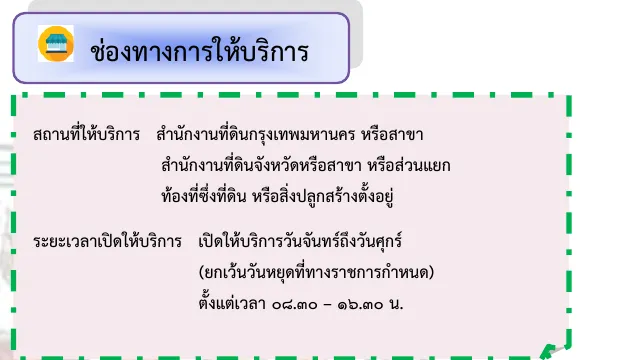
Land offices open Monday to Friday from 08:30 to 16:30, except official holidays. Services are at the provincial land office, branch or sub-office for the area where the property stands.
Go first to the public-relations officer at the Land Office for advice, a document check and a queue ticket.
Not confirmed: Which bank paper a Land Office accepts as proof of the foreign money: the Act names none, and banks issue a credit advice. Whether a visa holder counts under the residence category or only through the foreign-money route. Ask the Land Office before paying a deposit.
Common questions
Can a foreigner buy a condo in Thailand?
A foreigner can hold a unit by bringing foreign currency into Thailand, or by withdrawing from a baht account of a person resident abroad or a foreign-currency deposit account. The total foreign share of the building is capped at 49%.
What is the 49% foreign quota?
Foreigners together may hold no more than 49% of the total unit area of each condominium building. The share is measured at the time the condominium was registered.
How do I prove the money came from abroad?
Evidence of foreign currency brought in, or withdrawn from a foreign-currency or non-resident baht account, in an amount not less than the price of the unit. The bank issues a credit or debit advice.
Do I still need a Foreign Exchange Transaction form?
The Bank of Thailand abolished the FX Form in 2017, whatever the amount. The bank gives a credit or debit advice as evidence.
Can a foreigner own land in Thailand?
A foreigner may acquire land only under a treaty that gives the right to own immovable property. Thailand has made no such treaty with any country since the 1970 treaty ended.
Is there a route to one rai of land?
Section 96 bis allows up to one rai for residence. It needs THB 40 million brought in for investment for at least five years, plus Interior Minister permission.
How long can a foreigner lease property?
The Land Office does not register a lease longer than 30 years. A separate Act covers commercial and industrial leases of more than 30 and up to 50 years.
What taxes apply when a unit is sold?
The seller pays specific business tax of 3.3% on the higher of the appraised value or the sale price. A sale registered more than five years after acquiring the property is outside that tax.
Do I need a certificate from the condominium?
The officer registers a transfer only when the unit is free of debts, shown by a certificate from the condominium juristic person. Its manager must issue the certificate to the owner.
Read next
General information checked against the sources listed above, not financial or tax advice for your situation. Rules and fees change; confirm with your bank, the Revenue Department or a licensed adviser before you act. See how guides are checked.
Spotted an error? Report it.