
Buying a Condo in Thailand as a Foreigner: What to Do in Order
You can buy a condo in Thailand as a foreigner if the money comes in from abroad, so send it first and keep the bank's evidence. You show that evidence at the Land Office when the unit is transferred. Expect to pay a 2% transfer fee, while the seller pays 3.3% specific business tax.
On this page
The order matters: money in from abroad first, bank evidence second, transfer at the Land Office third. Expect a 2% registration fee and, if the seller doesn’t pay specific business tax, a little stamp duty.
The purchase in order
- Send the money in. Bring foreign currency into Thailand, or withdraw it from a baht account of a person resident abroad or from a foreign-currency deposit account. Tell your bank the details of the transaction.
- Keep the bank’s evidence. After the transaction the bank issues you evidence of it. At USD 200,000 or more the bank asks for source-of-funds documents first.
- Get the no-debt certificate. The officer registers the transfer only when the unit is free of debts, and the condominium’s manager must issue the certificate to the owner.
- Transfer at the Land Office. The seller tells the official the foreign owners and their share of the building, and you show the evidence of the foreign currency.
- Pay the fees and taxes in the table below.
Why the money comes first
The evidence you show must be for an amount not less than the price of the unit, so send the full price from abroad and not less.
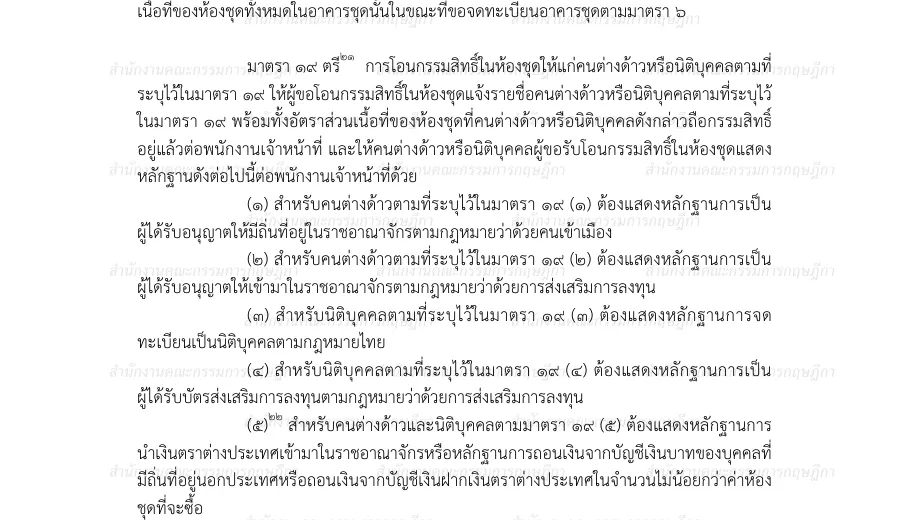
หรือถอนเงินจากบัญชีเงินฝากเงินตราต่างประเทศในจํานวนไม่น้อยกว่าค่าห้องชุดที่จะซื้อ
…or withdrawal from a foreign-currency deposit account, in an amount not less than the price of the unit to be bought.
Condominium Act B.E. 2522, section 19 ter (5)
Below USD 200,000 you state the purpose and the bank need not ask for documents. At USD 200,000 or more it asks where the money came from, and for property investment it does so transaction by transaction since 29 December 2025, so have those papers ready before you transfer. For the sending side, see how to send money to Thailand and opening a Thai bank account.
At the Land Office
Go to the land office for the area where the building stands. It is open Monday to Friday, except official holidays. On your first visit, start with the public-relations officer, who checks your documents and gives you a queue ticket.
When the papers are correct and the foreign share of the building is within the quota, the official registers the transfer. Foreigners together may hold no more than 49% of a building; the foreign condo quota page has the detail.
Fees and taxes
| Item | Rate | Who pays |
|---|---|---|
| Registration fee on a condominium transfer | 2% of appraised value, minimum THB 20 | Agree it in writing |
| Specific business tax | 3.3% of the higher of appraised value or sale price | The seller |
| Stamp duty | THB 1 for every THB 200, or part of THB 200 | Not charged where the person receiving the payment pays specific business tax |
A sale registered more than five years after the seller acquired the property is outside specific business tax, so ask the seller when they bought.
If you can’t buy: a lease
The Land Office does not register a lease longer than 30 years. A lease of more than three years must be in writing and registered, with a registration fee of 1%.
Before you pay a deposit
- Ask the seller for the foreign share already registered in the building.
- Ask for the no-debt certificate from the condominium manager, and allow up to 15 days for it.
- Ask to see the unit’s title deed (หนังสือกรรมสิทธิ์ห้องชุด), which is what gets registered at transfer.
- Agree in writing who pays the 2% registration fee.
- If you will rent the unit out or live there long term, read renting in Thailand and the moving to Thailand checklist.
More guides for settling in are on the living hub.
Step by step
- Send the money in from abroadBring foreign currency into Thailand, or withdraw from a non-resident baht account or a foreign-currency account, and tell the bank the details.
- Keep the bank's evidenceAfter the transaction the bank issues evidence; at USD 200,000 or more the bank asks for source-of-funds documents first.
- Get the no-debt certificateThe condominium's manager issues a certificate that the unit is free of debts.
- Transfer at the Land OfficeGo to the Land Office for the building's area; the seller discloses the foreign owners and their share, and you show the evidence.
- Pay the fees and taxesPay the 2% registration fee; the seller pays specific business tax of 3.3%.
Not confirmed: Who bears the 2% transfer fee: the fee schedule gives a rate and no payer, so agree it in writing before a deposit. Which bank paper a Land Office accepts as proof: the Act names no form.
Common questions
Can a foreigner buy a condo in Thailand?
A foreigner can hold a unit by bringing foreign currency into Thailand, or by withdrawing from a baht account of a person resident abroad or from a foreign-currency deposit account. Foreigners together may hold no more than 49% of a building.
Do I need documents when I send the money?
Below USD 200,000 you state the purpose and the bank need not ask for documents. At USD 200,000 or more it asks for documents showing the source of the money, and for property investment it does so transaction by transaction since 29 December 2025. You always tell the bank the details of the transaction.
What proof of the money does the Land Office want?
The evidence of foreign currency must be for an amount not less than the price of the unit. The bank issues you evidence after the transaction.
How much are the transfer fees?
The registration fee on a condominium transfer is 2% of the appraised value, with a minimum of THB 20. Stamp duty is THB 1 for every THB 200, or part of THB 200, unless the seller pays specific business tax.
Who pays the 3.3% specific business tax?
The seller pays it, on the appraised value or the sale price, whichever is higher. A sale registered more than five years after the seller acquired the property is outside it.
Do I need a certificate from the condominium?
The officer registers the transfer only when the unit is free of debts, shown by a certificate from the condominium juristic person. Its manager must issue the certificate to the unit owner.
Read next
Sources and reader comments
Official legal texts (Gazette, government portals):
- ค่าธรรมเนียม ภาษี และอากร — Department of Lands public service manual (fees, taxes, duties) (opens in a new tab)
- พระราชบัญญัติอาคารชุด พ.ศ. ๒๕๒๒ (ฉบับสำนักงานคณะกรรมการกฤษฎีกา) — Department of Lands (opens in a new tab)
- Bank of Thailand, Exchange Control Regulation (opens in a new tab)
- Bank of Thailand circular to banks ที่ ธปท.ว. 8434/2568 (26 Dec 2025): checks on foreign currency received from abroad (opens in a new tab)
- Bank of Thailand circular to banks ที่ ธปท.ว. 6126/2569 (29 Sep 2026), Annex 2: guidelines on foreign currency received from abroad (opens in a new tab)
Show 3 more sources
- Department of Lands citizen manual (registration of inheritance transfer): service place and opening hours (opens in a new tab)
- ติดต่อสำนักงานที่ดินจังหวัดเชียงใหม่ — Chiang Mai Provincial Land Office, Department of Lands (opens in a new tab)
- 235 การจดทะเบียนเช่า — Department of Lands manual (registering a lease) (opens in a new tab)
General information checked against the sources listed above. Prices, opening hours and other details change; confirm them with the provider before you act. See how guides are checked.
Spotted an error? Report it.