
Moving to Thailand: Visa, Housing, Money and First-Month Checklist
Pick your visa first, because the bank, the housing and the tax all follow from it. File the TDAC within 3 days before arrival. Once you move in, your landlord files the TM.30 within 24 hours. After that you report your address every 90 days. 180 days in a calendar year makes you a tax resident.
Work it out for your datesThailand move plannerA dated checklist from your arrival date: which step is due when, with the rule and source behind every date.On this page
Moving to Thailand goes smoothly if you decide in this order: visa, then address, then money. The visa comes first because the bank follows it, since KBank opens no account for holders of tourist-type visas, including the DTV.
Your landlord then files a TM.30 notice within 24 hours of you moving in, and you report your address every 90 days. Stay 180 days in a calendar year and you are a tax resident. The diagram and checklist below put the early deadlines in order.
Pick your visa
Start from what you will do here, not from the visa name. Each row links to the full guide with fees, documents and the office that handles it.
| Route | Stay | What it needs |
|---|---|---|
| Visa exemption (guide) | 30 days | Tourism only; cash of THB 20,000 per person |
| DTV (guide) | 180 days per entry | For remote work: an employment contract, certificate or professional portfolio |
| Retirement Non-O (guide) | 90 days, then a 1-year extension | Age 50 or over; THB 800,000 in a bank or THB 65,000 a month |
| Marriage Non-O (guide) | 90 days, then up to 1 year | A Thai spouse; THB 400,000 in a Thai bank for 2 months, or THB 40,000 a month |
| Work Non-B (guide) | 90 days, then 1 year with a work permit | Ministry of Labour approval letter |
| LTR (guide) | 10 years | A BOI letter of endorsement |
For remote work, the DTV is the usual pick: it is built for remote workers and freelancers, though it bars a Thai work permit and work for Thai companies or Thai clients. The visa types overview sets every category side by side, and the visa changes page carries the newest rules.
If you only need a little longer, a visa-exempt visitor can ask for one extension of up to 30 days for THB 1,900. Overstaying costs THB 500 a day, up to THB 20,000.
Moving with a pet? Our guide to bringing a pet to Thailand covers the permit. Marrying a Thai partner? See marriage registration in Thailand.
Before you fly
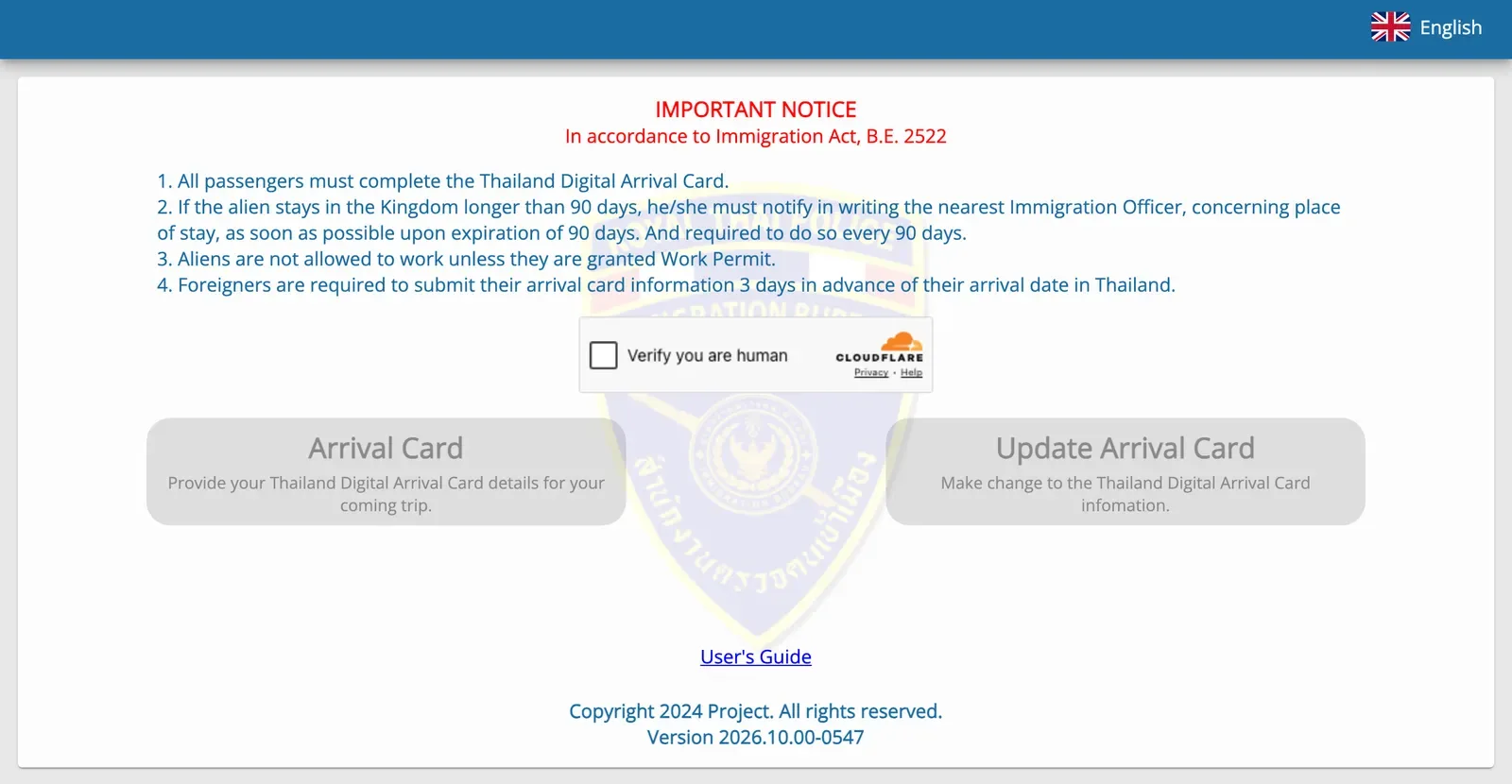
File the Thailand Digital Arrival Card online within 3 days before arrival. It is free, and the only official site is tdac.immigration.go.th. The TDAC guide covers the steps and lookalike sites.
At the checkpoint, read the last permitted date on your stamp before you leave the counter.
The first weeks
Enter your arrival date in the move planner to get this checklist with your own dates.
- Ask your landlord to file the TM.30 within 24 hours of move-in, and ask for the printed proof. See the TM.30 guide.
- Register your SIM with your passport before use. See the eSIM and SIM guide.
- Open a bank account once you hold a non-immigrant visa. See opening a bank account.
- Buy a re-entry permit before any trip abroad: THB 1,000 for one trip or THB 3,800 for multiple trips. See the re-entry permit guide.
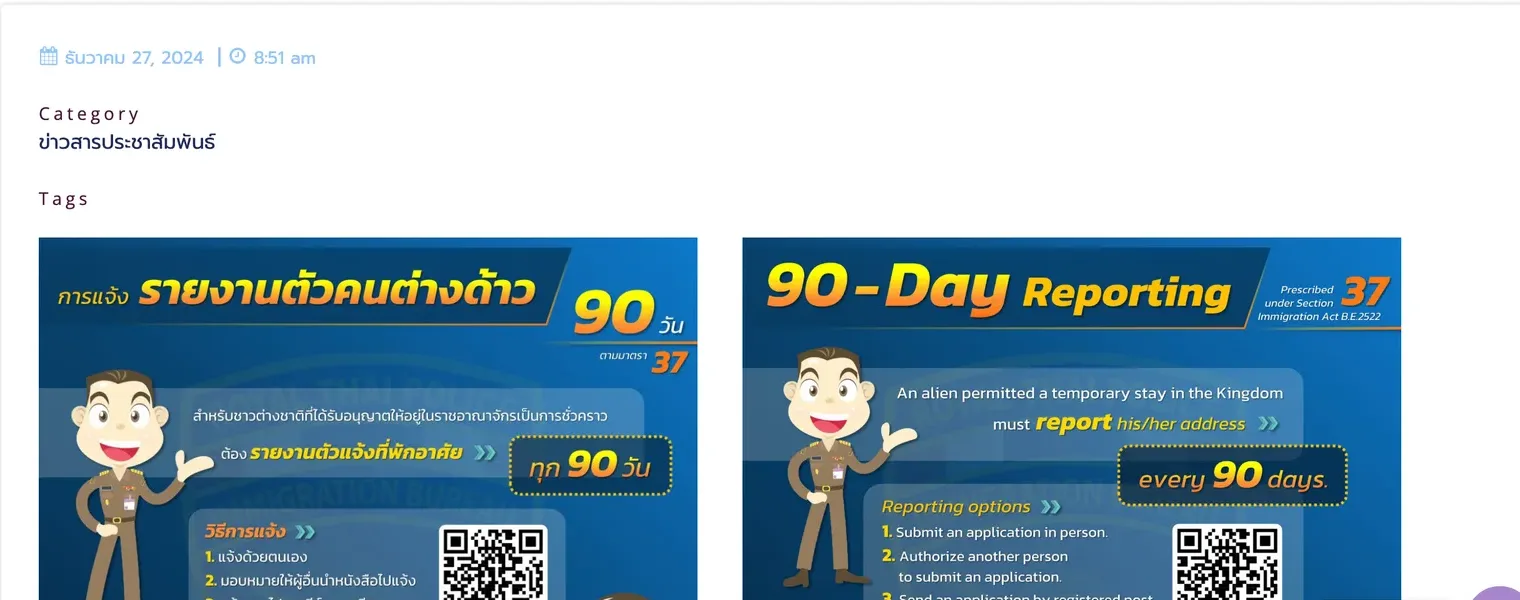
- Report your address from 15 days before to 7 days after each 90-day due date. See the 90-day report guide.
- Count your days toward the 180-day tax line. See tax residency.
- Apply for any extension while your permitted stay still runs. See extending a stay.
The 90-day report starts once a permitted stay passes 90 days, and leaving Thailand restarts the count. A late report is made in person with a THB 2,000 fine. LTR holders report once a year instead.
Housing
Rent depends on the district, and where to live in Bangkok compares the expat districts by transit, schools and immigration access.
Before you sign, know the basics. A short-term lease runs three years at most, and advance rent and deposit together may not exceed three months of rent. The deposit comes back within seven days after the lease ends if there is no damage. If you are overcharged for water or electricity, call the OCPB hotline 1166.
The TM.30 duty sits with the owner, landlord or operator, and a host who fails to file faces a fine of up to THB 2,000. For your rights as a tenant, see renting in Thailand: the law.
Thinking of buying? Foreigners together may own up to 49% of a condominium’s unit area. See buying a condo in Thailand as a foreigner. Land is a different matter: a foreigner may acquire land only under a treaty, and no such treaty is in force.
Banking and moving money
Open the account after the visa is in place. KBank asks for a passport and a non-immigrant visa of any type, Krungsri will not open one on a tourist visa, and Bangkok Bank needs you at a branch in person. Once you are in, PromptPay links your account to a phone number. The PromptPay and banking apps guide covers each bank’s app.
A foreign Visa card pays THB 250 per ATM withdrawal at KBank, so withdraw larger amounts less often. The ATM fee guide covers the other banks.
To bring money in, the sender states a purpose for each transfer. See sending money to Thailand. Carrying cash needs a Customs declaration above THB 450,000 in baht or USD 15,000 in foreign notes; see the cash declaration guide.
Tax
Be in Thailand 180 days or more between 1 January and 31 December and you are a tax resident for that year. A stay of 179 days is not. A resident is taxed on foreign income earned from 1 January 2024 and remitted in the same or a later tax year. Read foreign income and residency and remote-worker tax before you move savings.
Health insurance
Insurance rules follow the visa: O-A needs cover of at least USD 100,000, and O-X needs a Thai policy. Even without a visa rule, get cover, because hospitals ask for a guarantee of payment before treatment. Call 1669 for a medical emergency.
The expat health insurance guide compares what each visa asks for, and hospital costs has price lists. Moving with children? See international schools in Thailand.
Working legally
A foreigner may not work without a work permit. Foreign workers without permits face fines of THB 5,000 to THB 50,000 and deportation. The work permit guide walks through the application.
Driving
Carry an international driving permit with your home licence. A 1968 permit stops being valid once you establish normal residence in Thailand, so residents apply for a Thai licence. See the driving licence guide and the IDP guide.
Chiang Mai and Phuket
City detail lives on the sister sites. Chiang Mai Jao (opens in a new tab) covers neighbourhoods, rent and daily life in Chiang Mai, and Phuket Anchor (opens in a new tab) does the same for Phuket. The national steps above apply in both cities. This site also has the Chiang Mai overview and the Phuket overview. More guides on settling in are in the living cluster.
Not confirmed: Banks publish their own paper lists, and branches may ask for more. The Cabinet approved a draft change to residence notifications on 23 June 2026. It is a draft, not law.
Common questions
Which visa should I use for a long stay in Thailand?
The DTV suits remote work and gives 180 days per entry. Retirement and marriage visas lead to a 1-year extension, a Non-B visa leads to a work permit, and the LTR runs 10 years.
Can I open a Thai bank account on a DTV?
KBank does not open accounts for holders of tourist-type visas, including the DTV. It asks for a non-immigrant visa of any type. Check other banks before you go.
Who files the TM.30 when I rent a home?
The owner, landlord or operator files it, within 24 hours of you taking up residence. A host who fails faces a fine of up to THB 2,000.
How often is the 90-day report due?
Every 90 days once a permitted stay passes 90 days. You can report from 15 days before to 7 days after the due date. LTR holders report once a year instead.
When do I become a Thai tax resident?
At 180 days or more in Thailand between 1 January and 31 December. A stay of 179 days does not count. A resident is taxed on foreign income earned from 1 January 2024 and remitted in the same or a later tax year.
Can I work remotely on a DTV?
The DTV is meant for remote workers and freelancers. It bars a Thai work permit and work for Thai companies or Thai clients.
Do I need health insurance to move to Thailand?
Some visas ask for it: O-A needs at least USD 100,000 of cover. O-X needs a Thai policy. Hospitals also ask for a guarantee of payment before treatment.
Can I drive with my home licence?
Carry an international driving permit with it. A 1968 permit stops being valid once you establish normal residence in Thailand, and residents then apply for a Thai licence.
Read next
Sources and reader comments
Official legal texts (Gazette, government portals):
- Phitsanulok Immigration: procedure for notifying foreigner residence (TM.30) for premises, posted 24 Dec 2024 (opens in a new tab)
- Phitsanulok Immigration (ตม.จว.พิษณุโลก): procedure for notifying a stay over 90 days (TM.47), posted 27 Dec 2024 (opens in a new tab)
- Q&A คำสั่งกรมสรรพากร ที่ ป.161 และ ป.162 — Revenue Department (กองกฎหมาย) (opens in a new tab)
- Royal Thai Embassy, London: Thailand Digital Arrival Card (TDAC) required from 1 May 2025 (opens in a new tab)
- Royal Thai Embassy London, Destination Thailand Visa page (updated 8 Sep 2026) (opens in a new tab)
Show 41 more sources
- Royal Thai Embassy Phnom Penh, Non-Immigrant O Visa (Retirement) page (opens in a new tab)
- Royal Thai Embassy in Malaysia: checklist Non-Immigrant Visa (O) for Dependant, spouse of a Thai citizen (MFA-hosted PDF, undated) (opens in a new tab)
- Thai Ministry of Foreign Affairs website: checklist for the Non-Immigrant B and IB visa for employment, fee shown in Malaysian ringgit (an embassy checklist hosted on image.mfa.go.th) (opens in a new tab)
- Thailand BOI, LTR Visa Thailand - Long Term Resident Program (ltr.boi.go.th) (opens in a new tab)
- Immigration Act B.E. 2522, consolidated Thai text with amendment footnotes (Phuket Immigration Office copy, last footnote 2018) (opens in a new tab)
- Revenue Department (English) - Guide to Personal Income Tax Return 2024 (PND.90) (opens in a new tab)
- Ministry of Foreign Affairs of Thailand, DTV infographic (July 2024) (opens in a new tab)
- Royal Thai Embassy, Budapest — Destination Thailand Visa (DTV) page (opens in a new tab)
- Royal Thai Embassy Oslo, Non-Immigrant O-A (Long-stay) page (updated 15 Sep 2026) (opens in a new tab)
- Royal Thai Embassy Oslo, Non-Immigrant Visa O-X (Long Stay 10 years) page (opens in a new tab)
- GOV.UK (FCDO) Thailand travel advice: Health (opens in a new tab)
- Phetchabun Provincial Immigration Office (Immigration Bureau): Getting Your First Thai Driving License (page undated) (opens in a new tab)
- UN Treaty Series vol. 1042 I-15705: Convention on Road Traffic, Vienna, 8 November 1968 (Article 41, Annex 7, Thailand declaration) (opens in a new tab)
- กฎกระทรวง การขอและการออกใบอนุญาตขับรถ และการต่ออายุใบอนุญาตขับรถ พ.ศ. 2563 — ราชกิจจานุเบกษา 22 ต.ค. 2563 (via DLT legal office) (opens in a new tab)
- Ministry of Tourism and Sports: Tourism Ministry warns of fake TDAC websites charging fees (opens in a new tab)
- Royal Thai Embassy, London: Visa Exemption and Visa on Arrival Schemes (effective 15 Sep 2026) (opens in a new tab)
- Immigration Bureau Public Handbook: Application for Re-Entry Permit, TM.8 (hosted on chiangmai.immigration.go.th O8 page; published 8 Nov 2019) (opens in a new tab)
- Royal Thai Embassy, Doha: Tourist Visa Exemption & Visa-on-Arrival (updated 16 Sep 2026) (opens in a new tab)
- Royal Thai Embassy Oslo, Non-Immigrant O (Retirement) page (opens in a new tab)
- Immigration Bureau Order No. 12/2568 (23 Jan 2025), clauses 1-7 on pp. 1-2 (scanned) plus the criteria table (clause 2) and annexes A-C on pp. 3-30; copy hosted by Chiang Rai Immigration (uploaded 2025-03-05); pdf pages 1-2 are images, read by eye (opens in a new tab)
- Royal Thai Embassy Oslo, Non-Immigrant Business & Investor Visa (Non-B) page (opens in a new tab)
- Ministry of Foreign Affairs of Thailand: Types of Visa slide deck (PDF created 31 Aug 2026; file name 69.08.31) (opens in a new tab)
- Immigration Division 1 Bangkok (immigration.go.th subdomain), Fee page, Wayback Machine snapshot of 2024-08-09 (live page blocks automated fetch) (opens in a new tab)
- Royal Thai Embassy, Washington D.C.: Advice on Thailand Visa Overstay Regulations (14 Sep 2023) (opens in a new tab)
- Immigration Bureau TM.30 online system manual: notifying foreigners and exporting proof (archived 21 Apr 2025) (opens in a new tab)
- Royal Gazette vol. 142 special part 211 Ngor, pp. 80-84 (6 Jun 2025): Contract Committee notice making residential building rental a contract-controlled business B.E. 2568, with standard contract forms (copy hosted by OCPB) (opens in a new tab)
- Office of the Consumer Protection Board (OCPB): apartment water and electricity inspections, 18 December 2025 (Thai) (opens in a new tab)
- พระราชบัญญัติอาคารชุด พ.ศ. ๒๕๒๒ (ฉบับสำนักงานคณะกรรมการกฤษฎีกา) — Department of Lands (opens in a new tab)
- Department of Lands, Acquisition of Land by Alien (English page, Wayback capture 4 Aug 2025) (opens in a new tab)
- PromptPay — Bank of Thailand (opens in a new tab)
- Exchange Control Regulation - Bank of Thailand (opens in a new tab)
- National Institute for Emergency Medicine (niems.go.th), home page, Wayback snapshot of 2 Apr 2026 (opens in a new tab)
- พระราชกำหนดการบริหารจัดการการทำงานของคนต่างด้าว (ฉบับที่ ๒) พ.ศ. ๒๕๖๑ — Royal Gazette vol. 135 part 19 ก, 27 March 2018 (copy hosted by the Department of Employment) (opens in a new tab)
- Ministry of Labour (English news), Labour Minister emphasizes Trai Thep Phithak task force crackdown, posted 15 May 2025 (opens in a new tab)
Company and press pages (not official sources):
- Open Bank Account (savings) — Kasikornbank (opens in a new tab)
- Cabinet meeting summary, 23 June 2026 (text of thaigov.go.th summary, copy hosted by Thaipublica) (opens in a new tab)
- AIS: SIM & plans for tourist (AIS Lucky Tourist SIM) (opens in a new tab)
- Foreign Currency Deposit — Krungsri (Bank of Ayudhya) (opens in a new tab)
- Bangkok Bank: Foreign Customers FAQs (opens in a new tab)
- Kasikornbank (KBank): Announcement Table 3, service fees, effective 22 September 2026 (opens in a new tab)
- Bangkok Bank: FAQs about transferring funds into Thailand (opens in a new tab)
General information checked against the sources listed above. Prices, opening hours and other details change; confirm them with the provider before you act. See how guides are checked.
Spotted an error? Report it.