
Thailand Tax Residency: 180 Days and Foreign Income
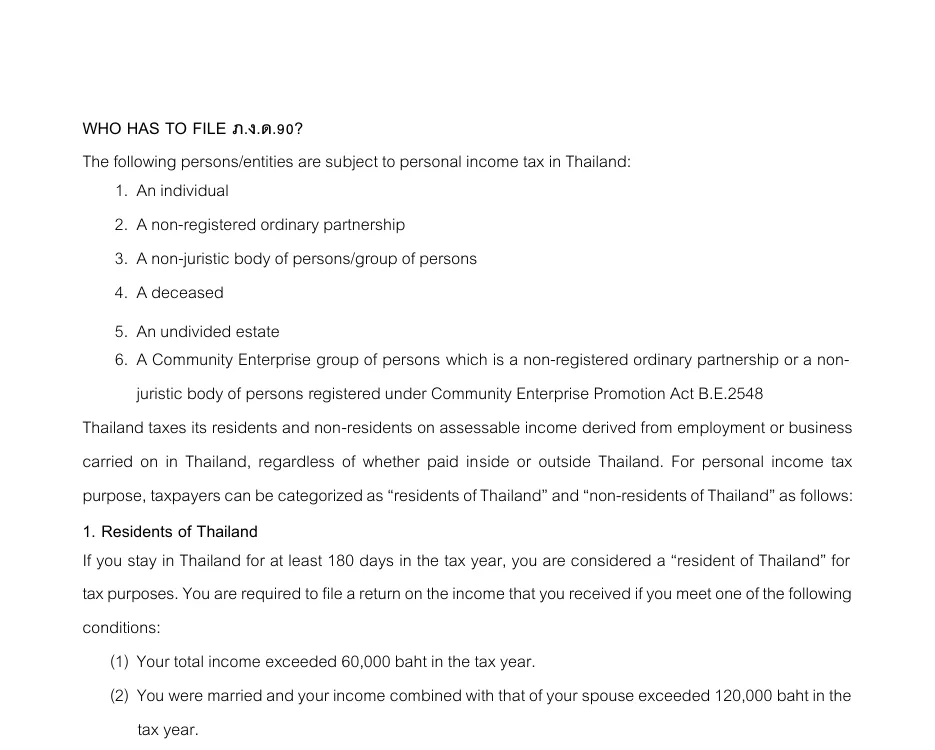
You are a Thai tax resident after 180 days or more in a calendar year. Foreign income earned from 1 January 2024 is taxed only when you bring it into Thailand in that year or a later one. Income earned before 2024 is left out. A treaty country gives a credit for tax paid abroad.
On this page
You become a Thai tax resident at 180 days in a calendar year. For foreign income the date that counts is 1 January 2024. Earn it from that date, bring it into Thailand, and it is taxed.
The rules come from Revenue Code section 41 and two Revenue Department orders, P.161/2566 and P.162/2566. They apply whatever your nationality.
The 180-day test
The Revenue Department counts days from 1 January to 31 December of the tax year, whether in one stay or several. Nationality and ethnicity are not taken into account. Section 41 says the same: periods totalling 180 days in a tax year make you resident.
A DTV stay can run 180 days per entry, the same figure as the tax test. See the DTV guide for the visa side.
| Case | Result |
|---|---|
| 179 days in Thailand from January to December | Not a resident that year |
| Days split over two years, 150 in the later year | Not a resident in either year |
| 180 days or more in a calendar year | Resident that year |
What is taxed after 1 January 2024
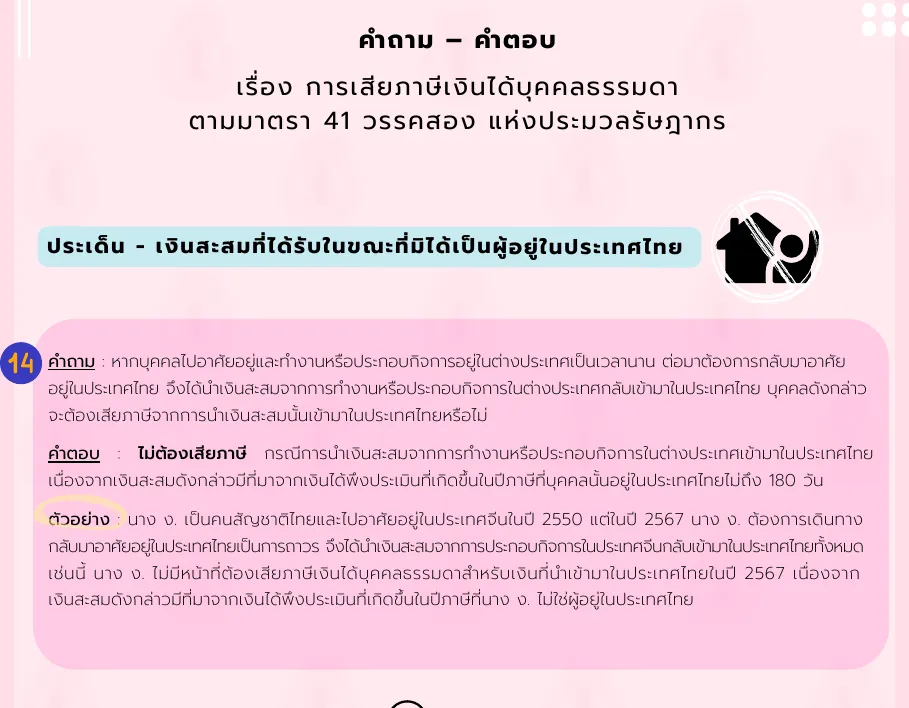
A resident with income from work, business or property abroad is taxed on it when it is brought into Thailand. Order P.161/2566 says the person adds that income to the tax computation for the year it was brought in.
เข้ามาในประเทศไทยในปีภาษีใดก็ตาม ให้บุคคลนั้นมีหน้าที่ต้องนำเงินได้พึงประเมินนั้นมารวมคำนวณ
“… brought into Thailand in whichever tax year, that person must include that assessable income in the computation …”
Revenue Department Order Por. 161/2566, clause 1
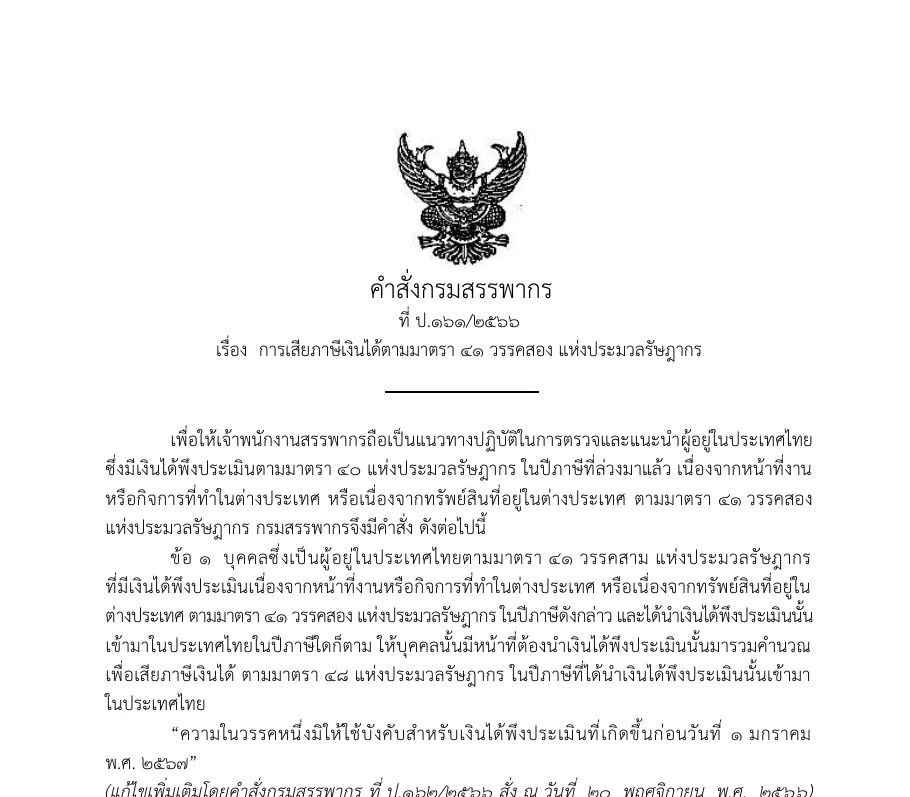
The order applies to income brought into Thailand from 1 January 2024. Order P.162/2566 of 20 November 2023 left out income that arose before that date. Two conditions must both be met:
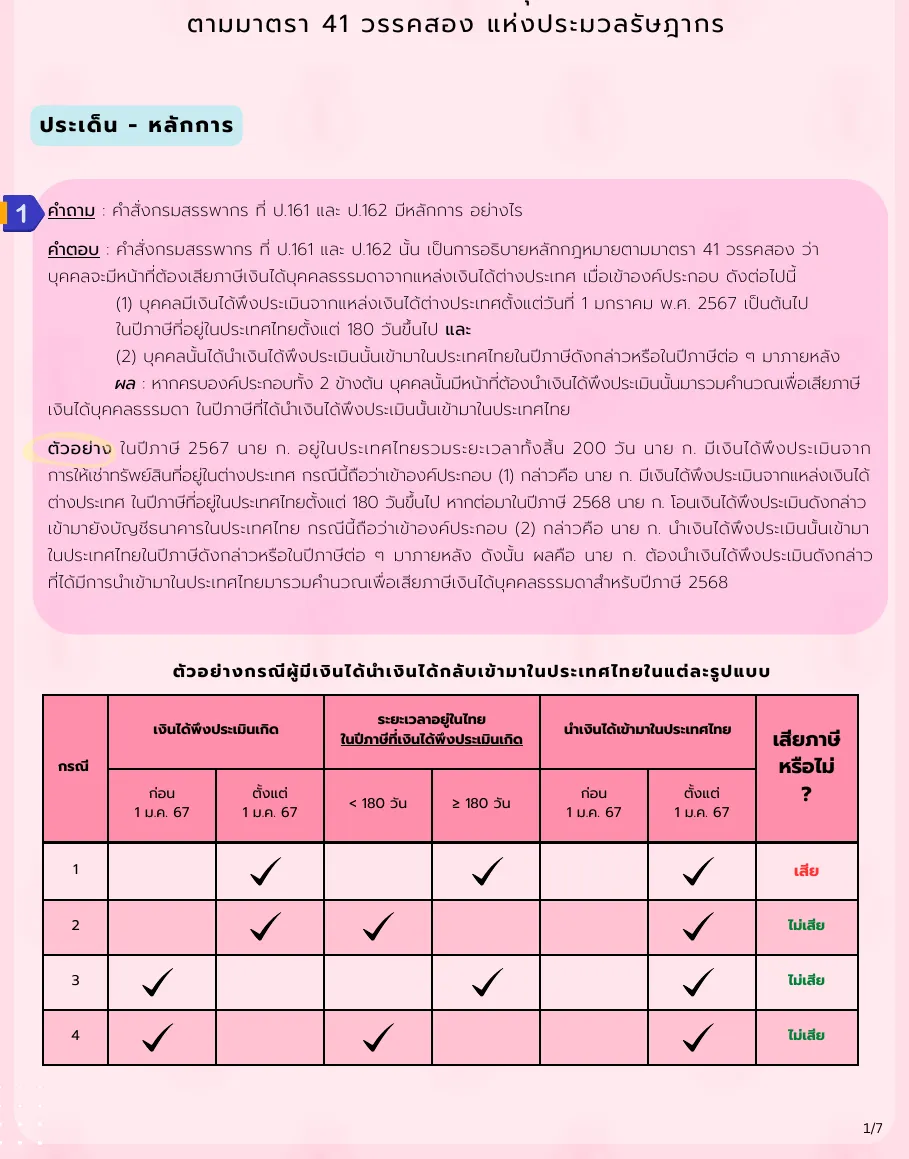
- You earned the income from 1 January 2024, in a year you were in Thailand 180 days or more.
- You bring it into Thailand in that tax year or a later one.
Foreign-sourced income means work, business or other activity abroad, including employment with a foreign company. You count as resident for this in the year the income arises, and the income is assessable once remitted.
What counts as bringing money in
Any method counts: a bank transfer, an online transfer or carrying the money in. See the cash declaration limits if you carry it. Assessable income means income under section 40(1) to (8); exempt items such as an inheritance stay exempt.
The Department’s own case
In one example a person spends 200 days in Thailand in tax year 2567 and earns rent on foreign property. He moves it to a Thai bank account in 2568 and includes it in his Thai income tax for 2568.
What stays tax-free
These are the cases the Department’s Q&A treats as outside the tax:
- Foreign bank interest of tax year 2566, brought in during 2568, because it arose before 1 January 2567.
- Income of a year you spent under 180 days in Thailand, even when brought in. In the Department’s example a person with 65 days owed nothing on rent moved in the same year.
- Savings built up abroad in years under 180 days.
- Deposit principal: only the interest is taxed. Your own investment money sent abroad and brought back is not income.
- Shares that rose in price but were not sold. Gains are worked out per transaction, and only the part above what you invested is income.
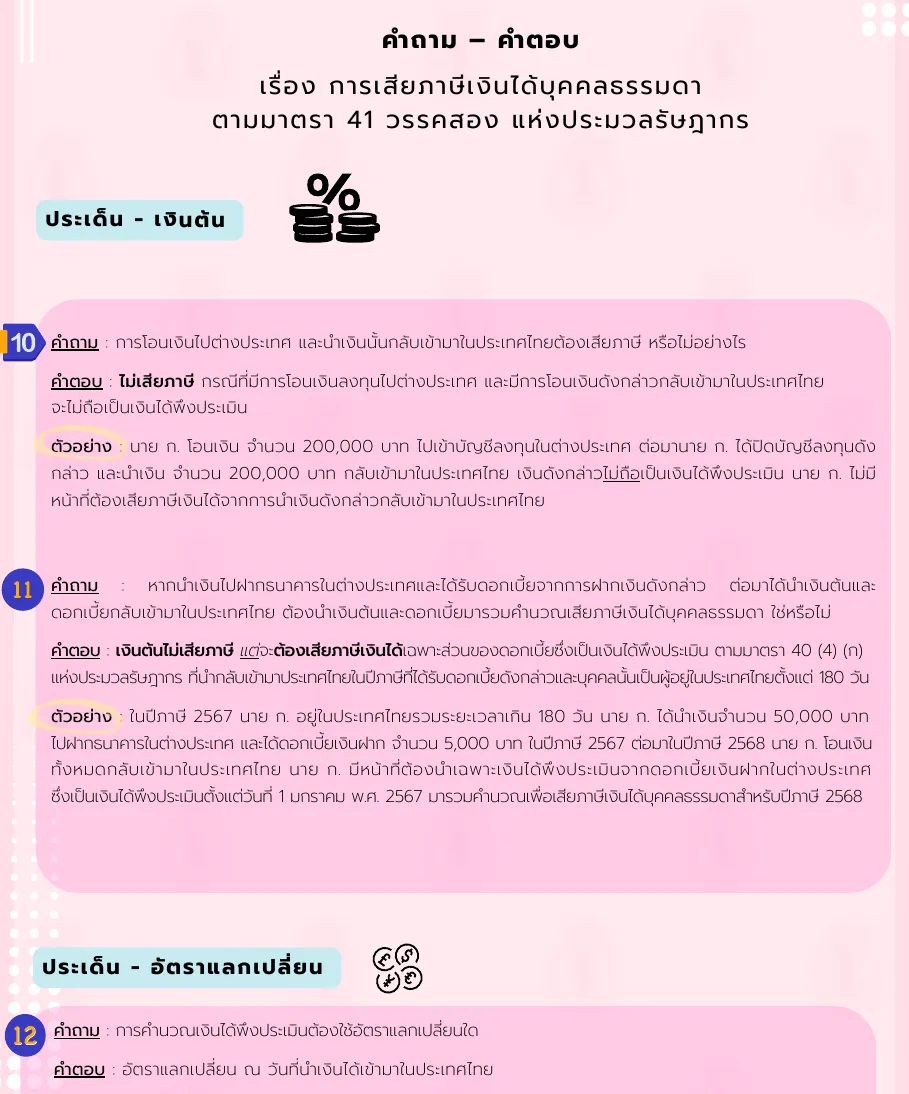
When you bring money back in several parts, you work out yourself whether each part is income or capital.
Credit for tax paid abroad
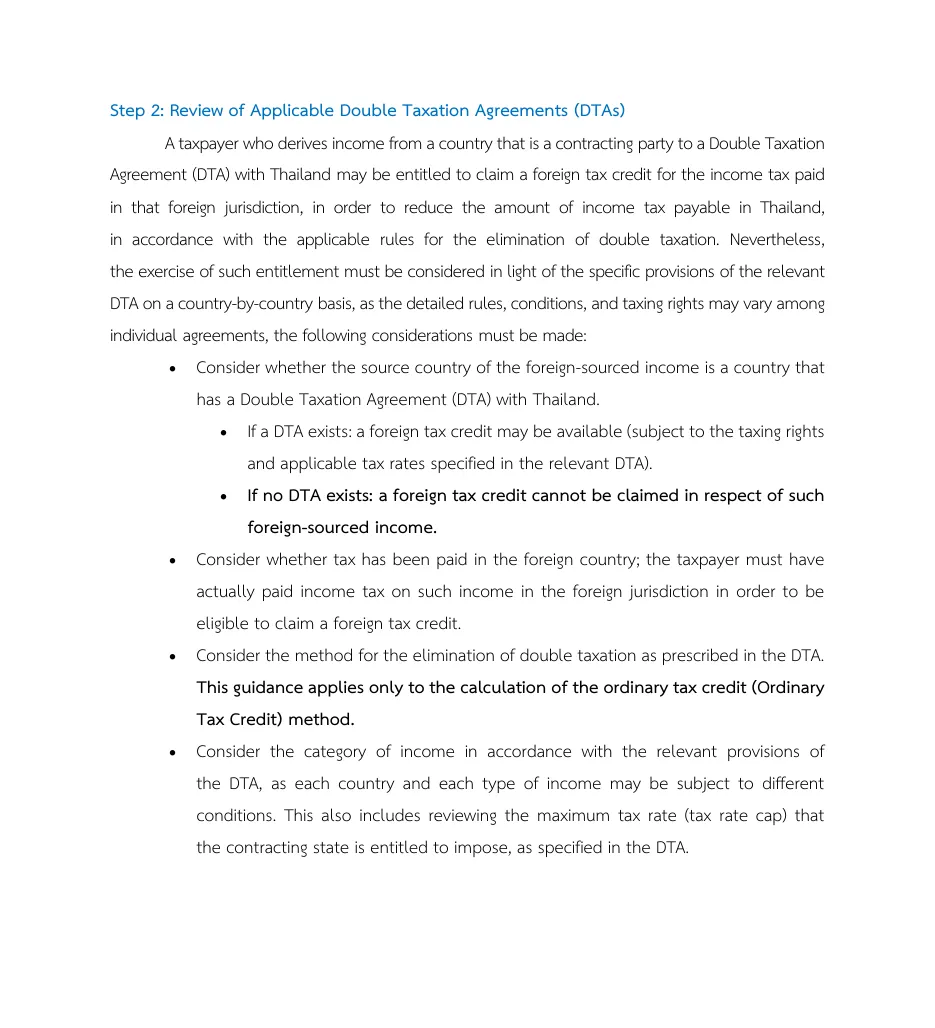
A resident can credit tax paid abroad against Thai tax for the year the income comes in, under the treaty with that country. Thailand has treaties with 61 countries. With no treaty there is no credit.
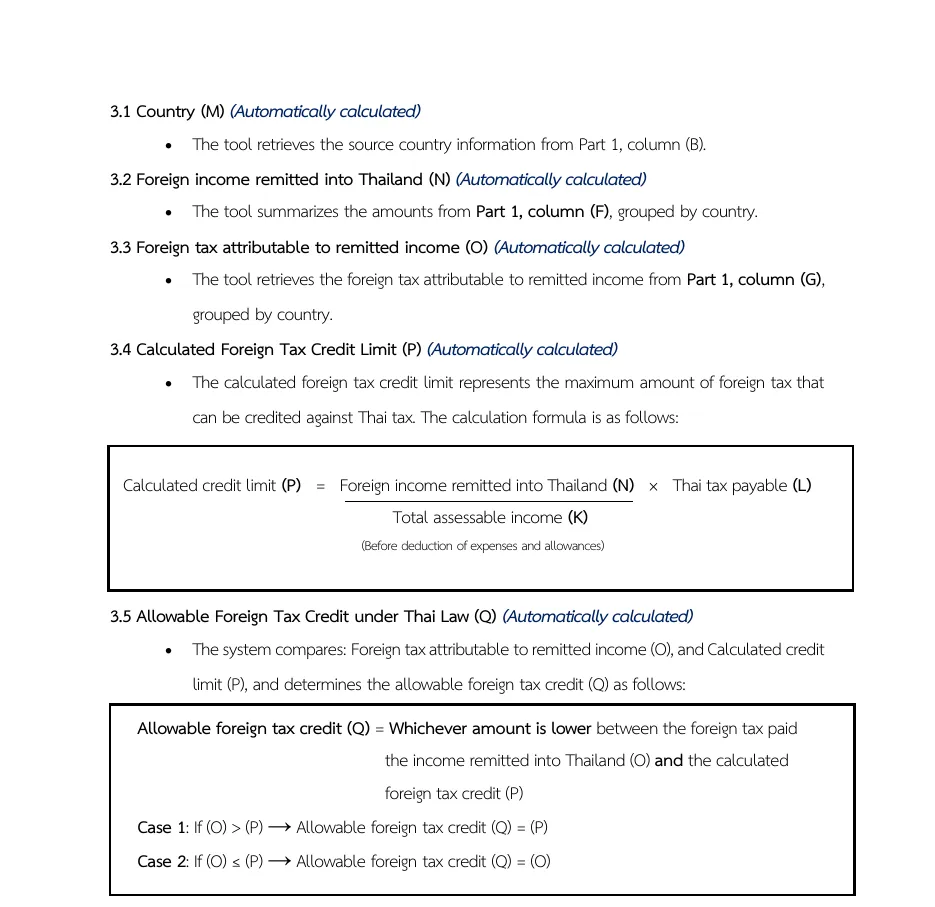
The Department’s credit manual sets the working rules:
- Only income tax you actually paid on that income counts.
- The credit cannot exceed the Thai tax on that part of the income, and foreign penalties and surcharges are not included.
- Excess foreign tax cannot be carried forward to later years.
- Work out each source country and each income type separately.
The limit is foreign income remitted multiplied by Thai tax payable, divided by total assessable income before expenses and allowances.
Convert to baht with a commercial bank rate on the remittance day or the Bank of Thailand reference rate of the previous business day. In the Department’s example USD 1,000 comes to THB 36,200 at the bank rate and THB 36,150 at the Bank of Thailand rate. The Department also publishes a credit calculation tool with an English manual.
Keep your foreign tax return, withholding certificates, tax receipts and transfer slips. You report the income and credit on P.N.D. 90 or P.N.D. 91.
Your residence status under a treaty can differ from your Thai domestic status. The treaty counts you as resident after 180 days in aggregate in a tax year. Treaties cover income taxes only. Where the Revenue Code rate and the treaty rate differ, the rate more favourable to you applies.
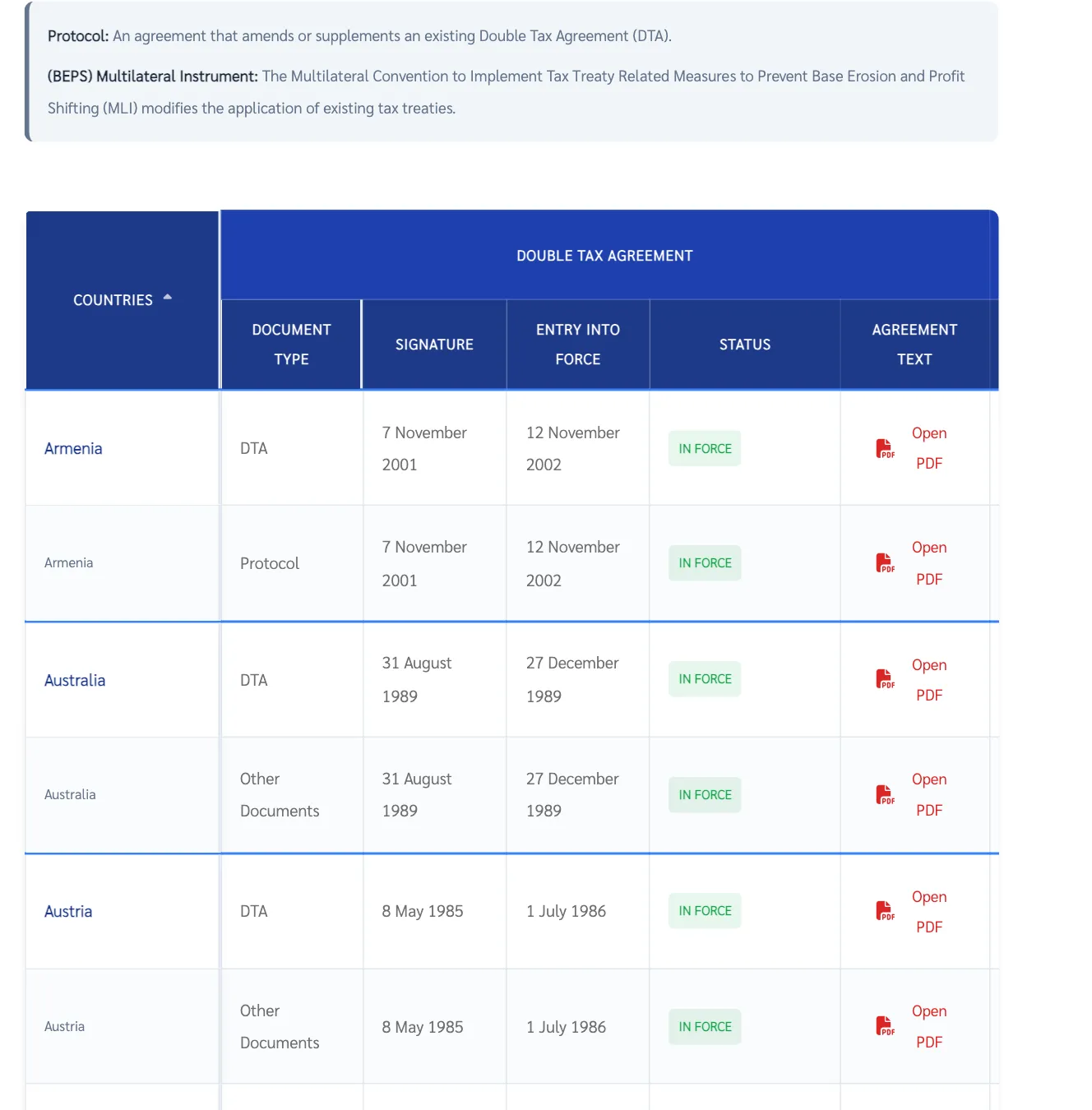
Treaties with common home countries
| Country | Signed | In force from |
|---|---|---|
| United States | 26 November 1996 | 15 December 1997 |
| United Kingdom | 18 February 1981 | 20 November 1981 |
| Canada | 11 April 1984 | 16 July 1985 |
| Australia | 31 August 1989 | 27 December 1989 |
| Germany | 10 July 1967 | 4 December 1968 |
| France | 27 December 1974 | 29 August 1975 |
| Netherlands | 11 September 1975 | 9 June 1976 |
| Japan | 7 April 1990 | 30 August 1990 |
| Korea | 16 November 2006 | 29 June 2007 |
| India | 29 June 2015 | 5 January 2016 |
| China | 27 October 1986 | 29 December 1986 |
| Russia | 23 September 1999 | 15 January 2009 |
| Singapore | 11 June 2015 | 15 February 2016 |
| Switzerland | 12 February 1996 | 19 December 1996 |
| Vietnam | 23 December 1992 | 31 December 1992 |
The Department’s list shows only an air transport agreement for Saudi Arabia, not a full income tax treaty.
Tax rates on the income you declare
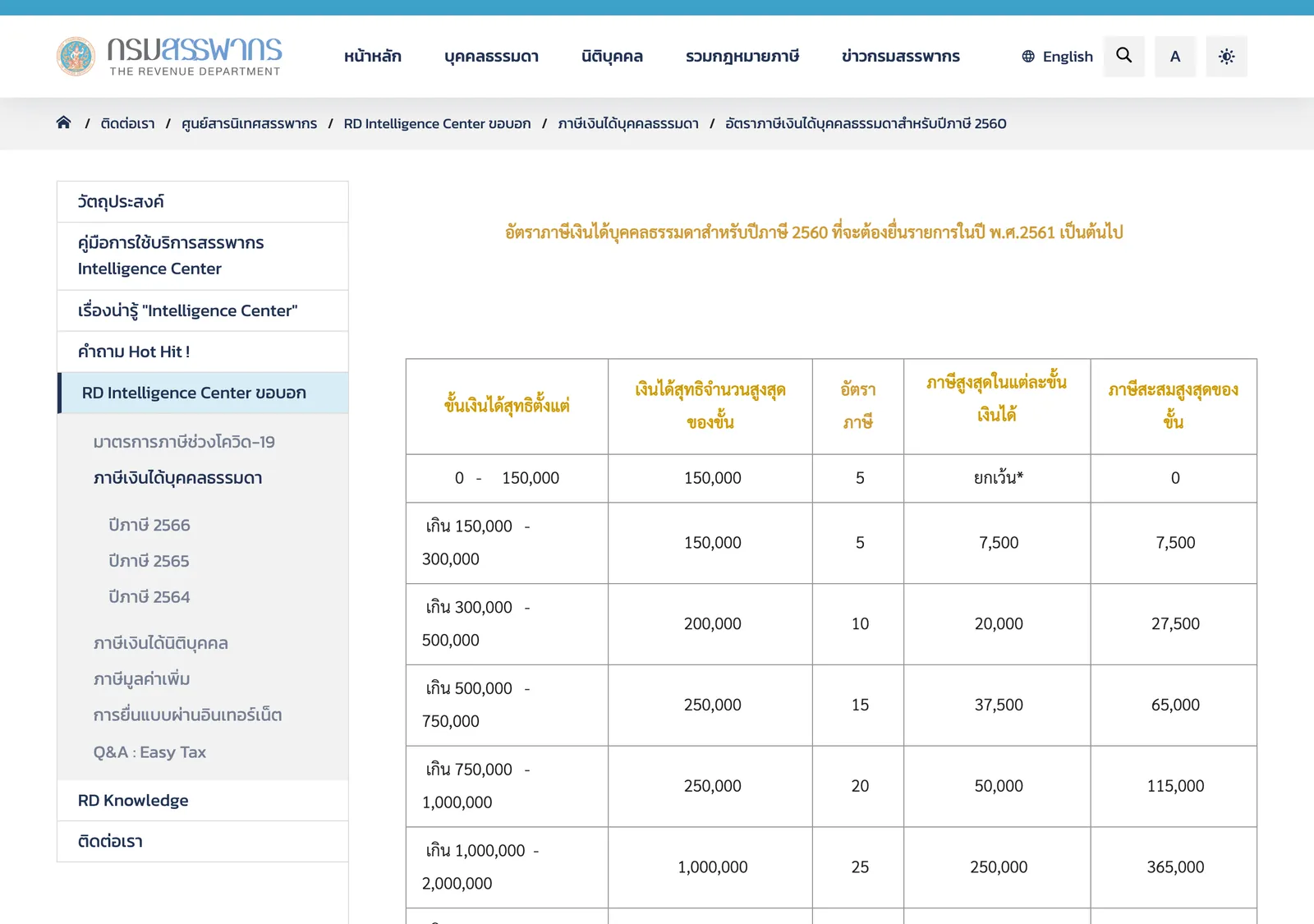
The first THB 150,000 of net income is exempt. Net income is what remains after expenses and allowances.
| Net income band (THB) | Rate | Tax at the top of the band |
|---|---|---|
| 0 to 150,000 | Exempt | THB 0 |
| 150,000 to 300,000 | 5% | THB 7,500 |
| 300,000 to 500,000 | 10% | THB 27,500 |
| 500,000 to 750,000 | 15% | THB 65,000 |
| 750,000 to 1,000,000 | 20% | THB 115,000 |
| 1,000,000 to 2,000,000 | 25% | THB 365,000 |
| 2,000,000 to 5,000,000 | 30% | THB 1,265,000 |
| Over 5,000,000 | 35% | - |
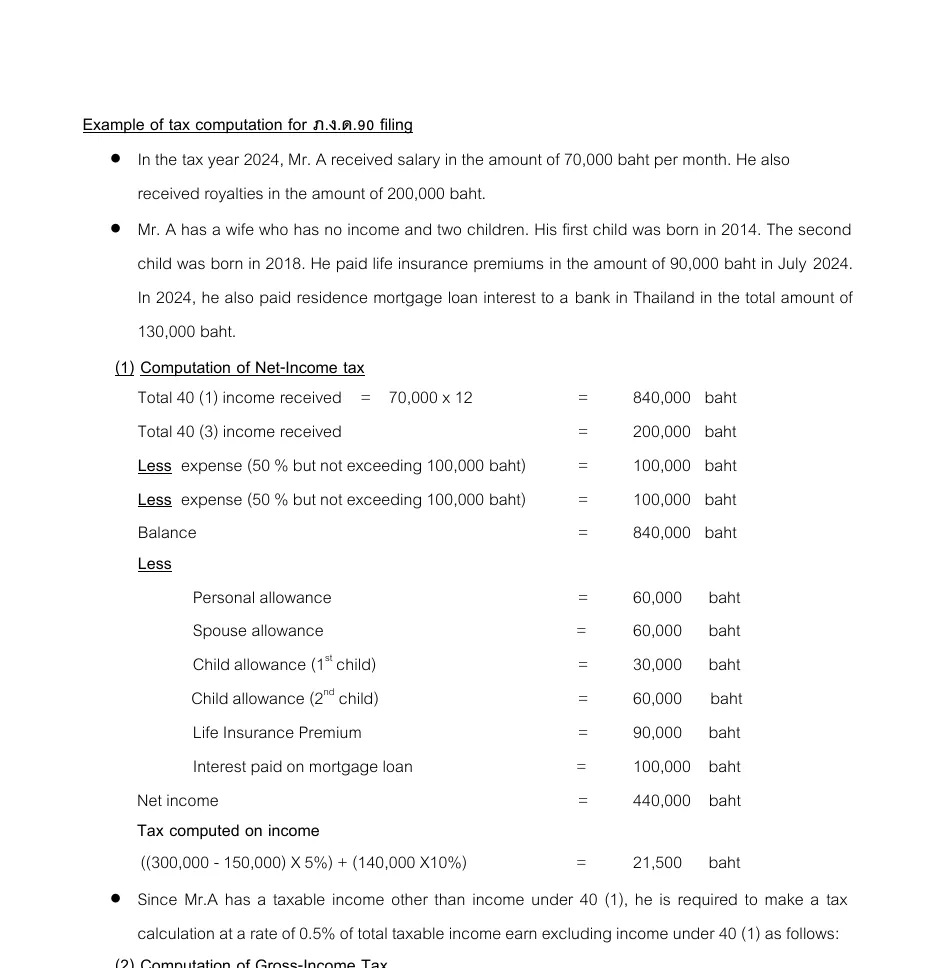
In the Department’s worked example, net income of THB 440,000 gives tax of THB 21,500. The example uses a personal allowance of THB 60,000. Employment expenses come off at 50%, up to THB 100,000.
If income other than employment income is THB 120,000 or more, the tax is the greater of the net-income tax and 0.5% of that gross income.
How to file
P.N.D. 90 is the general return; with employment income only you use P.N.D. 91. A resident files if total income exceeded THB 60,000, or THB 120,000 combined with a spouse. A non-resident files if there is Thai-taxable income and the same limits are met.
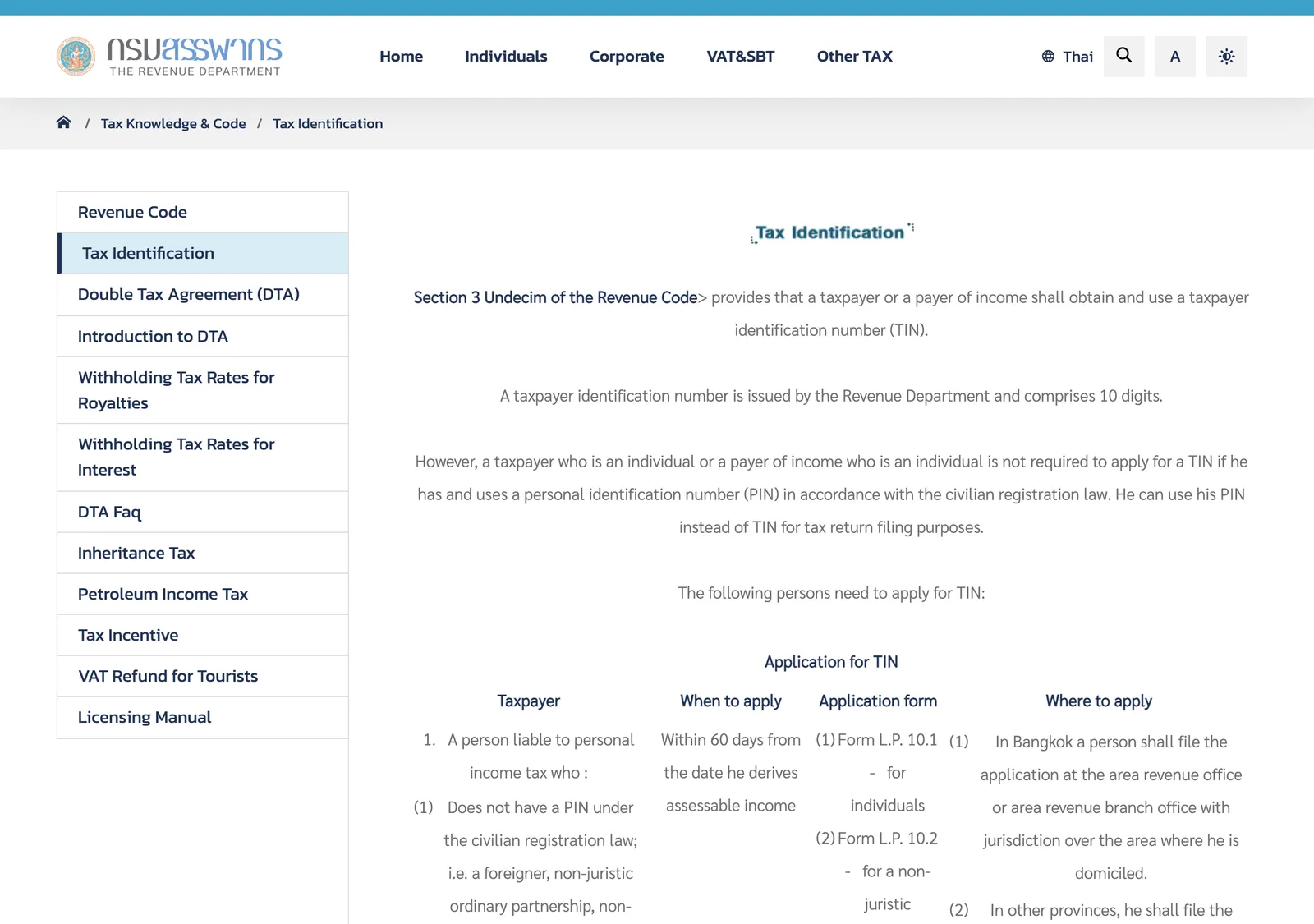
- Get a taxpayer number. A foreigner with no Thai personal ID number must apply. A stay of one period up to 14 days and 90 days in total in a tax year needs none.
- Apply within 60 days of first income on form L.P. 10.1 with a passport copy. Outside Bangkok any area revenue office takes it.
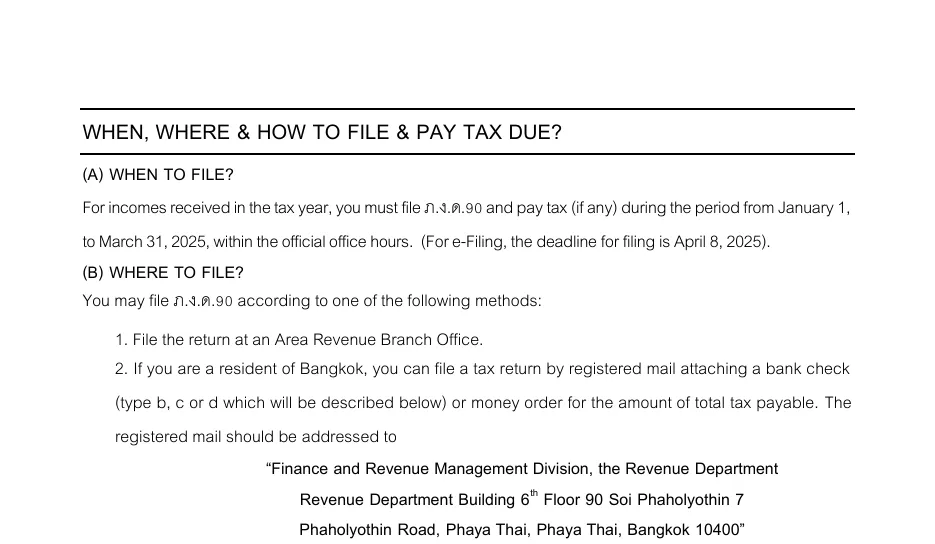
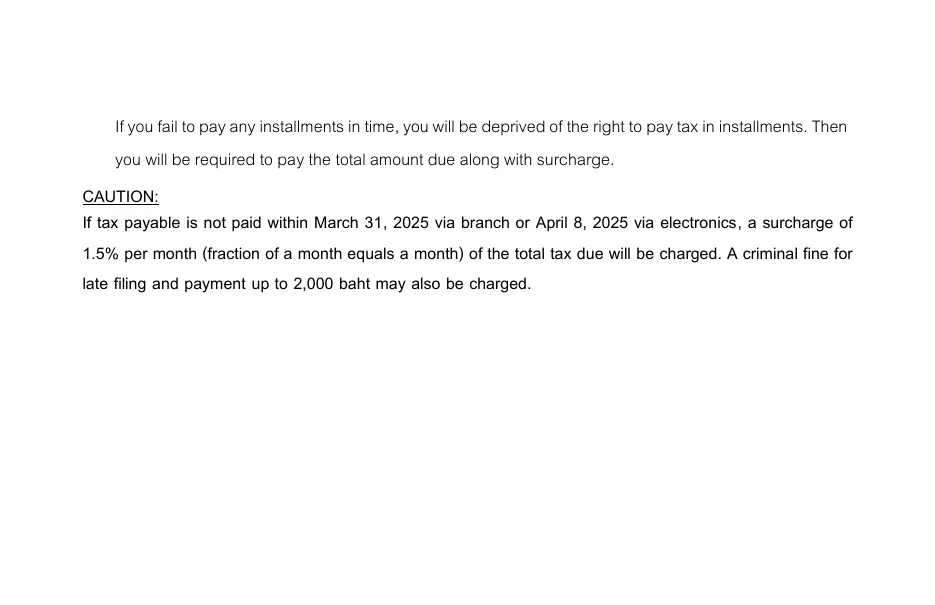
- File by the deadline. For tax year 2025, paper filing ran 1 January to 31 March 2026 and e-Filing to 8 April 2026. For tax year 2024 the dates were 31 March 2025 and 8 April 2025.
- E-Filing adds an automatic eight days.
- With tax of THB 3,000 or more you may ask to pay in three equal instalments.
Late filing and refunds
Late payment brings a surcharge of 1.5% of the tax due per month, and a criminal fine of up to THB 2,000 may be charged. A foreigner owed a refund gets a cheque by post to the mailing address on the return. Questions go to the Department’s line, 1161.
Step by step
- Get a taxpayer numberA foreigner with no Thai personal ID number applies on form L.P. 10.1 with a passport copy within 60 days of first income.
- Check whether you fileA resident files if total income exceeded THB 60,000, or THB 120,000 combined with a spouse. A non-resident files if there is Thai-taxable income above the same limits.
- Pick the formP.N.D. 90 is the general return. With employment income only you use P.N.D. 91.
- File by the deadlineFor tax year 2025, paper filing ran 1 January to 31 March 2026 and e-Filing to 8 April 2026. E-Filing adds eight days.
- Pay in full or in three partsWith tax of THB 3,000 or more you may ask to pay in three equal instalments.
Not confirmed: A plan to relax the remittance rule was reported in 2026. No replacing order has appeared on rd.go.th, so Order P.161/2566 stands. Check the Department's new-laws list before you move money. The Department pages do not say how arrival and departure days count, so keep your passport stamps. Dates for tax year 2026 are not out.
Common questions
Do I pay Thai tax if I stay under 180 days?
Foreign income of that year is not taxed even if you bring it into Thailand. Income from work or business done in Thailand is taxed whether it is paid inside or outside the country.
Is money I earned before 2024 taxed when I bring it in?
No. Income that arose before 1 January 2024 is left out of the rule, even if you bring it in later. Savings built up in years under 180 days are also free.
Do I pay tax on a foreign deposit I bring back?
The principal is not taxed. Only the interest is taxed, when it is brought in during the tax year you received it and you were in Thailand 180 days.
Do the 180 days have to be in a row?
No. One period or several count, added up between 1 January and 31 December.
How are days split across two calendar years treated?
Each calendar year stands alone. In the Department's example, 150 days in the later year left the person a resident in neither year.
Can I deduct tax I already paid at home?
You can credit tax paid abroad against Thai tax if a double tax agreement with that country applies. With no treaty there is no credit.
Which exchange rate do I use?
Either a commercial bank rate on the remittance day or the Bank of Thailand reference rate at the end of the business day before it.
Does a foreigner need a tax ID to file?
A foreigner with no Thai personal ID number must apply for a taxpayer number. A stay of one period up to 14 days and 90 days in total in a tax year needs none.
Read next
General information checked against the sources listed above, not financial or tax advice for your situation. Rules and fees change; confirm with your bank, the Revenue Department or a licensed adviser before you act. See how guides are checked.
Spotted an error? Report it.