
Thailand Royal and Etiquette Laws: Section 112 Carries 3 to 15 Years
Section 112 of the Criminal Code carries 3 to 15 years in prison for defaming, insulting or threatening the King, Queen, heir-apparent or regent. Acts against the flag to insult the nation carry up to 2 years or THB 40,000. Taking a Buddha image abroad needs a Fine Arts Department licence. Head, feet, monk and anthem rules are customs.
On this page
Two Thai rules here are criminal law with a prison term. One is a licence rule with a fee. The rest is custom, and the page that states each custom gives no penalty.
Law or custom: what carries a penalty
Section 112 of the Criminal Code carries imprisonment of 3 to 15 years. Section 118 carries up to 2 years or a fine of up to THB 40,000. These two are statutes with a stated penalty.
| Rule | Type | What the source gives |
|---|---|---|
| Insulting the monarchy, section 112 | Criminal law | 3 to 15 years in prison |
| Acts against the flag, section 118 | Criminal law | Up to 2 years or THB 40,000 |
| Taking a Buddha image out of Thailand | Licence rule | Fine Arts Department licence, 8 days, fee THB 100 to 2,000 |
| Dress at the Grand Palace and temples | Site rule | The list each site publishes |
| Head, feet, monks, national anthem | Custom | Thai government etiquette page, no penalty stated |
The licence rule sits between the two groups. The Fine Arts Department issues the licence, and Customs treats these goods as permit goods. Site rules belong to the temple or palace that publishes them.
Section 112: the statute text and penalty
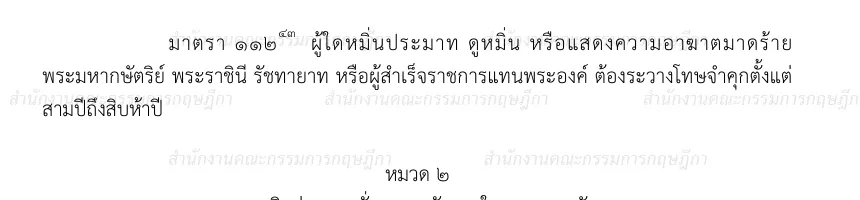
Section 112 of the Criminal Code sets imprisonment of 3 to 15 years. It covers defaming, insulting or threatening the King, Queen, heir-apparent or regent. The text names four office holders: the King, the Queen, the heir-apparent and the regent.
พระมหากษัตริย์ พระราชินี รัชทายาท หรือผู้สําเร็จราชการแทนพระองค์ ต้องระวางโทษจําคุกตั้งแต่ … สามปี ถึงสิบห้าปี
Section 112 sets imprisonment from three years to fifteen years for the offence against the King, Queen, heir-apparent or regent.
Criminal Code B.E. 2499, section 112, Council of State consolidated text
The conduct has three verbs in the Thai text: defame, insult and threaten, the last meaning expressing malice. The penalty is a range. The lower end is 3 years and the upper end is 15.
Section 118: acts against the flag
Section 118 punishes any act against the flag or another emblem that stands for the state. The act must be done to insult the nation. The penalty is imprisonment of up to 2 years, or a fine of up to THB 40,000.
ผู้ใดกระทําการใด ๆ ต่อธงหรือเครื่องหมายอื่นใดอันมีความ … เพื่อเหยียดหยามประเทศชาติ … เกินสองปี หรือปรับไม่เกินสี่หมื่นบาท
Whoever does any act against the flag or other emblem that signifies the State, in order to insult the nation, shall be punished with imprisonment not exceeding two years or a fine not exceeding forty thousand baht.
Criminal Code B.E. 2499, section 118, Council of State consolidated text
The fine figure is the amended one in the consolidated text. A separate Flag Act also exists, and its text is not quoted here.

Taking a Buddha image out of Thailand
Buddha images, artifacts and antiques need a permit from the Fine Arts Department at Thai Customs. The department’s licence covers any antique or object of art taken out of the Kingdom. The fee table runs from the Ayutthaya period up to the present day.
Thai usage treats a Buddha image as a person. It is “invited” from one place to another, not “shipped” or “taken”. Use that word when you ask a shop about sending one home.
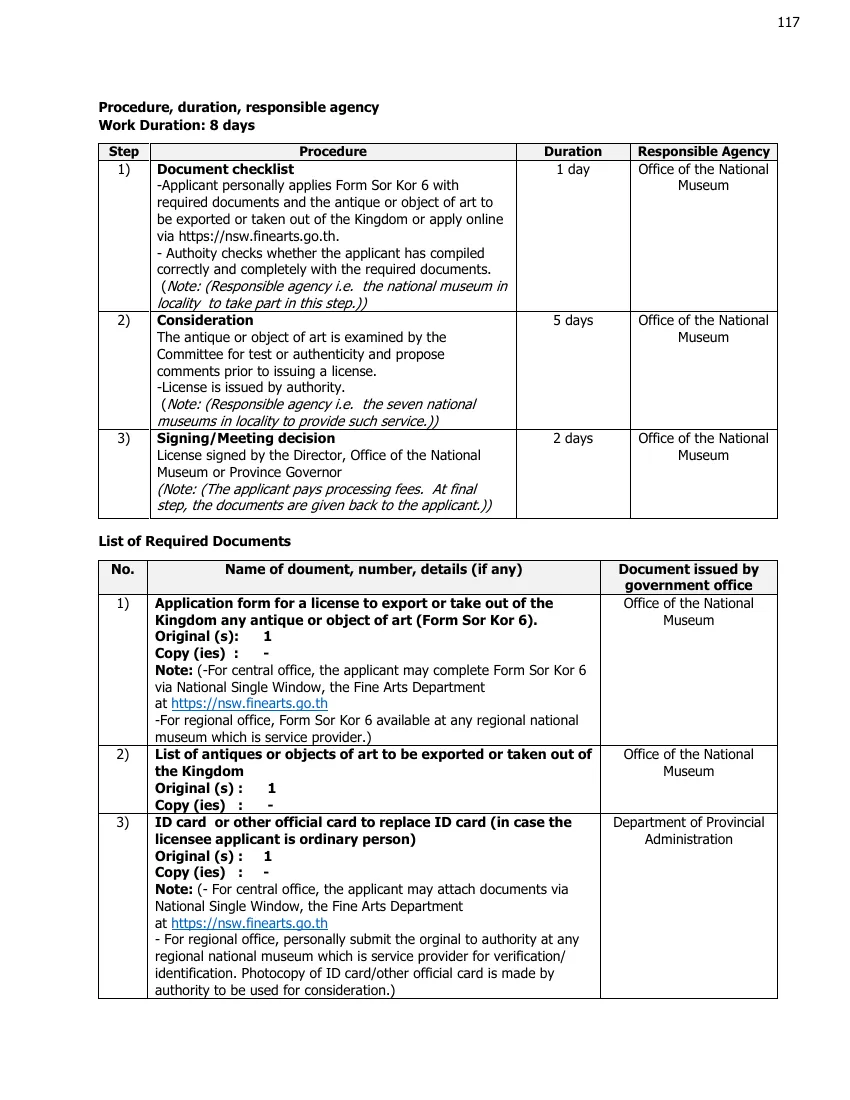
Here is the process the department publishes:
- Apply with Form Sor Kor 6, in person or online through nsw.finearts.go.th.
- The office checks your documents (1 day).
- A committee examines the object for authenticity (5 days).
- The licence is signed (2 days).
The department gives 8 days in total. The Office of National Museums in Bangkok takes applications at 81/1 Si Ayutthaya Road, Monday to Friday, 08:30 to 16:30.
You need these documents:
- Form Sor Kor 6
- a list of the objects
- your ID card or another official card
- proof of ownership, in 2 copies
- 2 colour photos of 9 x 12.5 cm
The fee is charged for each image and depends on its date and size. These rows show the range:
| Buddha statue or religious icon | Fee for each |
|---|---|
| Dated to the Ayutthaya period or earlier | THB 2,000 |
| Dated B.E. 2310 to 2453 (1767 to 1910), over 100 cm | THB 1,000 |
| Dated B.E. 2490 (1947) to the present, over 100 cm | THB 300 |
| Dated B.E. 2490 (1947) to the present, under 50 cm | THB 100 |
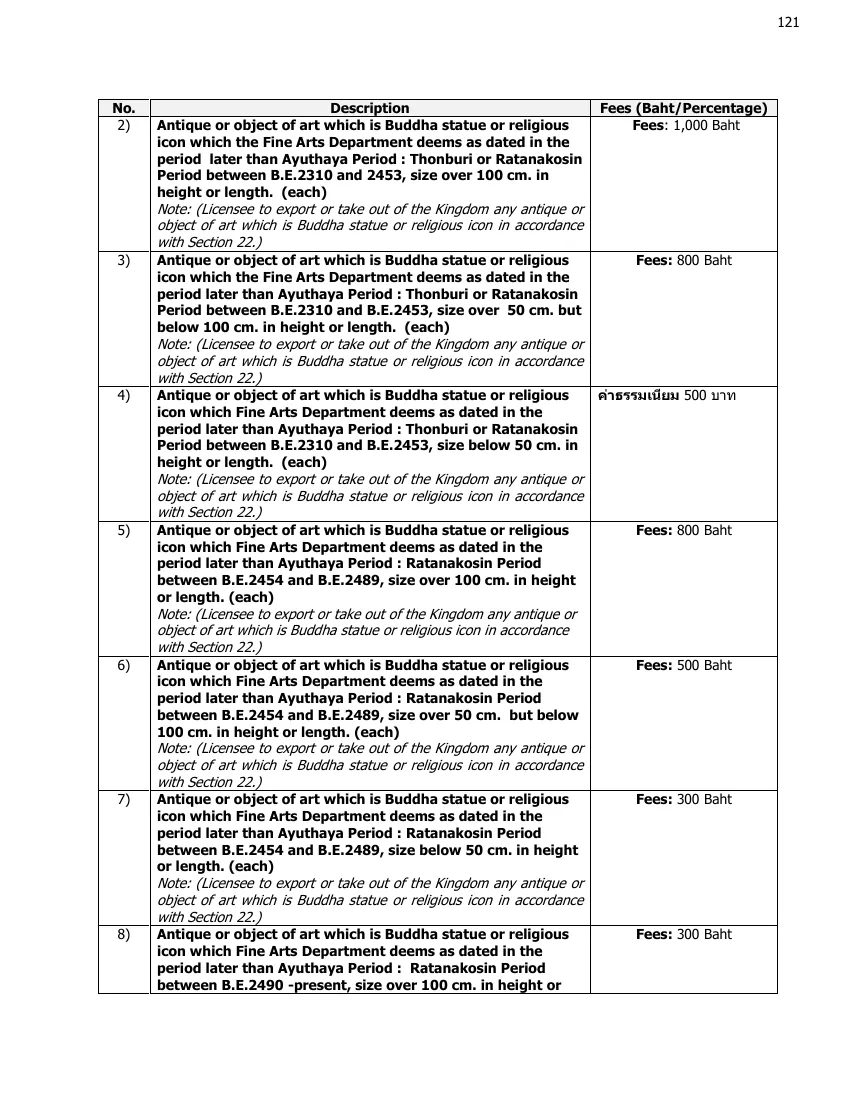
The manual lists more rows between these, by period and size. The wider customs rules for visitors are in the customs guide.
Temple and palace dress codes
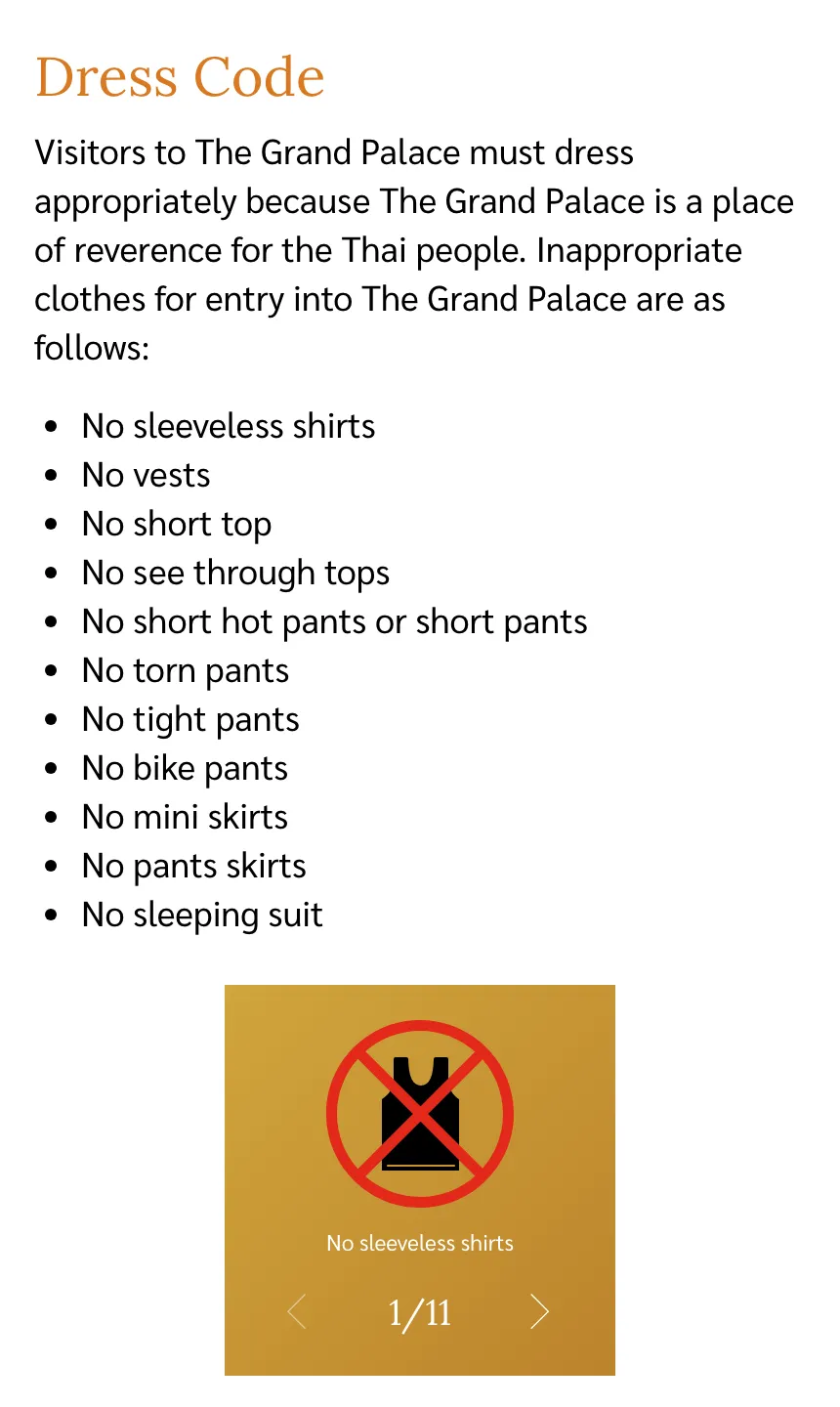
The Grand Palace requires appropriate dress because it is a place of reverence for the Thai people. Sleeveless shirts, vests, short tops, see-through tops and short pants are not allowed. Torn pants, tight pants, bike pants, mini skirts, pants skirts and sleeping suits are not allowed either.
| Site | Dress rule |
|---|---|
| Grand Palace | Appropriate dress; no sleeveless shirts, vests, short tops, see-through tops or short pants |
| Wat Arun | Respectful dress: no shorts, sleeveless tops, open shoulders or flip-flops |
| Wat Pho | Polite dress; shorts above the knees are prohibited for women; shoes come off before religious buildings |
The general rule is to dress properly when in temples. Each site above publishes its own list, so the list at the gate is the one that counts. Ticket prices and hours are in the Grand Palace guide, the Wat Pho guide and the Wat Arun guide.
Customs: head, feet, monks and the anthem
These rules come from the Thai government etiquette page. No penalty is stated for any of them.
- Head. Thai people regard the head as the highest part of the body. Do not touch another person’s head or pass things over your own.
- Feet. Do not use your feet to push or point at things. Do not step over people or over food or books.
- Monks. Women are forbidden from touching monks in any way under Thai tradition. Wat Pho adds that women may not touch monks or novices and may not enter areas set aside for monks’ rites.
- Buddha images. At Wat Pho, do not step on a Buddha image.
- Anthem. The national anthem plays at 8:00 a.m. and 6:00 p.m. every day, especially at public offices. Stand straight when you hear it.
Where to read more
The fines a visitor meets on the road, in shops and at checkpoints are in the guide to Thai laws and fines for tourists. If a rule goes wrong at a temple or a shop, the tourist police guide has the contact line.
Not confirmed: The separate Flag Act is not quoted; Criminal Code section 118 is. Penalties for damaging banknotes under the Currency Act were not found. The penalty for exporting a Buddha image without a licence is not in the Fine Arts manual.
Common questions
What is the penalty under section 112 in Thailand?
Section 112 sets imprisonment of 3 to 15 years. It covers defaming, insulting or threatening the King, Queen, heir-apparent or regent.
Is it a crime to insult the Thai flag?
Criminal Code section 118 carries up to 2 years in prison or a fine of up to THB 40,000. It covers any act against the flag or another state emblem to insult the nation.
Can I take a Buddha statue out of Thailand?
Buddha images, artifacts and antiques need a Fine Arts Department permit at Thai Customs. The department issues a licence to export or take out any antique or object of art.
How much does a Buddha image export licence cost?
The fee runs from THB 100 for a modern image under 50 cm to THB 2,000 for each image dated to the Ayutthaya period or earlier.
How long does a Fine Arts Department export licence take?
The department gives 8 days: 1 day for the document check, 5 days for the examination and 2 days for the signature.
Do I have to stand for the Thai national anthem?
The anthem plays at 8:00 a.m. and 6:00 p.m., and the custom is to stand straight when you hear it. No penalty is stated.
Can women touch monks in Thailand?
Under Thai tradition, women are forbidden from touching monks in any way. Wat Pho adds that women may not touch monks or novices.
What should I wear to the Grand Palace?
The palace requires appropriate dress. Sleeveless shirts, vests, short tops, see-through tops and short pants are not allowed.
Is pointing your feet at someone illegal in Thailand?
The Thai government etiquette page treats it as disrespect, not as a law: do not use your feet to push or point at objects.
Read next
General information checked against the sources listed above, not legal advice for your situation. Rules and office practice change; confirm with the immigration office or a licensed adviser before you act. See how guides are checked.
Spotted an error? Report it.