
Thailand With Kids: Where to Go, Car Seats, Health and Costs
In a Thai car, a child aged 6 or under needs a child safety seat or another method of protection, though hire vehicles and public vehicles are exempt. At group 1 to 3 national parks, a foreign child pays THB 50 to THB 150. Children and infants need a TDAC too.
On this page
Pack a car seat if your child is 6 or under, because in a private car the law says they must be in one. Taxis and hire vehicles are exempt, so the seat matters most on rentals and rides with friends. The rest of planning is mostly choosing a base with a decent hospital nearby and knowing what children pay.
Car seats, taxis and helmets
A child aged 6 or under must sit in a child safety seat or special child seat, or have another method of protection. Both rear-facing and forward-facing seats count, and so do booster seats without a backrest. Taller kids still need a belt: anyone no taller than 135 cm must be fastened to the seat in any row. Skipping the belt can cost up to THB 2,000.
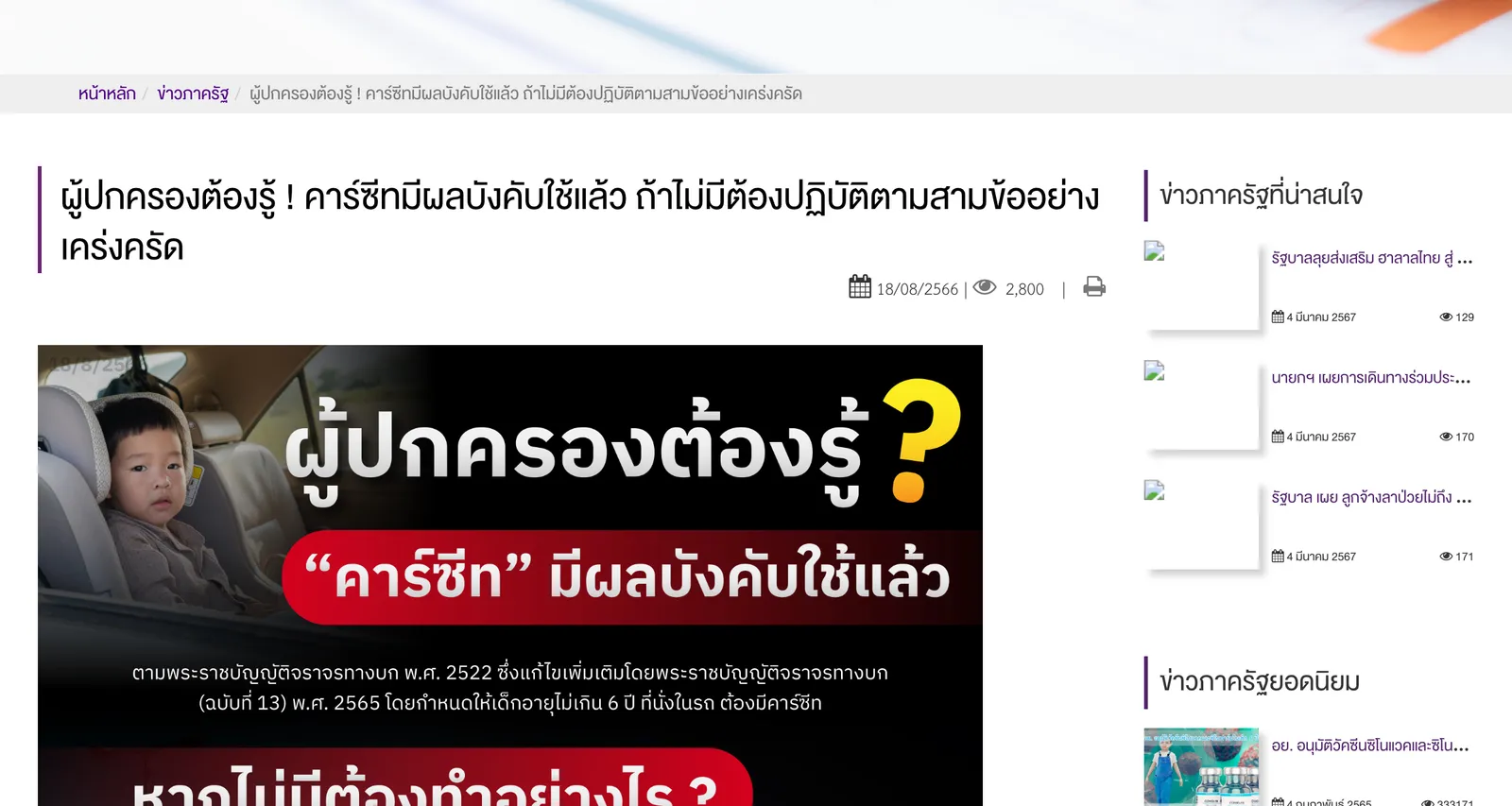
Taxis, Grab-type cars and other hire vehicles are exempt, so no seat is needed there. A self-drive rental is different, so follow the seat rule above.
If you truly have no seat, the law still treats you as correct when you meet all three conditions:
- Drive slowly and keep left.
- Seat the child in the rear.
- Have a carer with the child, or let the child wear only the lap belt.
Ignoring the rule can bring a fine of up to THB 2,000. The full text is on Thailand car seat law.
On a motorbike, riders and passengers must both wear a helmet, or face a fine of up to THB 2,000. If your passenger has none, you pay double. See helmets and traffic fines.
What children pay
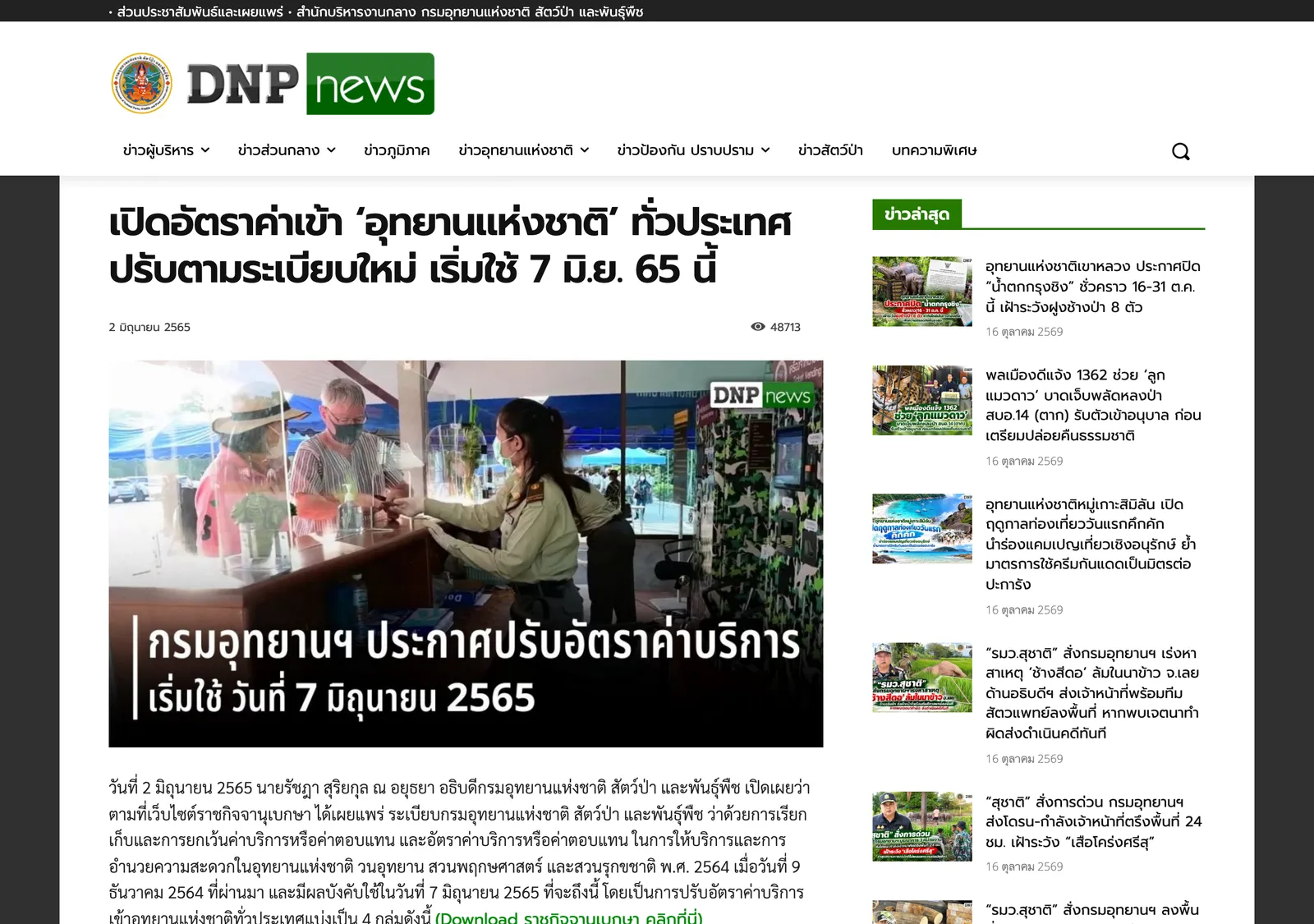
At national parks, a foreign child pays THB 50 in group 1, THB 100 in group 2, THB 150 in group 3 and THB 250 in group 4. Children under 3 pay nothing, and the child rate covers ages 3 to 14, or anyone not taller than 140 cm.
| Group | Parks you may know |
|---|---|
| 1 | Than Sadet-Ko Phangan |
| 2 | Ang Thong, Lanta, Khao Sok, Phi Phi, Khao Yai |
| 3 | Doi Inthanon, Erawan and Ao Phang Nga |
| 4 | Similan Islands and Surin Islands |
In the city, most sights go by height, not age. Children under 120 cm are free at the Grand Palace and at Wat Pho. At the Sanctuary of Truth in Pattaya, the limit is 110 cm. On the Bangkok metro, the MRT Blue Line is free up to 120 cm and the Yellow Line up to 90 cm.
Phuket’s Smart Bus lets children under 6 ride free with a paying adult. On the State Railway, children taller than 100 cm and up to 150 cm pay half fare.
Overnight to Chiang Mai, ask for coach 65 on train 9, a seating-and-sleeping coach for women and children. For the details, see Grand Palace tickets, Wat Pho tickets, BTS and MRT fares and national park fees.
Pick a base near a good hospital
Wherever you stay, know where the nearest hospital is before the first fever. The family islands comparison sets the island options side by side.
| Base | Nearest hospital |
|---|---|
| Bangkok: guide | BNH Hospital, adult and paediatric patients |
| Phuket: overview | Bangkok Hospital Phuket, 3rd Level Trauma Center |
| Koh Samui: guide | Bangkok Hospital Samui |
| Krabi and Ao Nang: guide | Krabi Hospital, A&E open 24 hours |
| Koh Phangan: guide | Ko Pha-ngan Hospital |
| Hua Hin: guide | Bangkok Hospital Hua Hin |
| Pattaya: guide | Bangkok Hospital Pattaya |
| Chiang Mai: guide | Bangkok Hospital Chiang Mai, open 24 hours |
Health and safety basics
Save 1669 in your phone for a medical emergency. It is meant for critically ill patients outside medical facilities, so a child who needs a doctor but is not critical is better taken straight to a hospital. More lines are on the Thailand emergency numbers page.
Sort out insurance before you fly: check it covers local treatment and unexpected evacuation. Private hospitals are of a high standard but can be expensive, and they want a guarantee of payment before treating patients. See travel insurance for Thailand.
After a bite or scratch from an animal that might be rabid, wash the wound with soap and water for at least 15 minutes and get medical help. Treatment can be given safely to infants. Read rabies and dog bites, and check vaccinations for Thailand: hepatitis A is recommended for children one year or older.
At the beach, learn the flags before anyone goes in. Two red flags mean absolutely no swimming, one red flag also means stay out, and a yellow flag means swim with caution.
Rip currents can occur at almost every beach. Jellyfish come close to shore from May to October, and their stings can be fatal. After a sting, get out, ask for help and call 1669. More in jellyfish and rip currents.
When to go
The hot season runs from mid-February to mid-May. The southwest monsoon follows from mid-May to mid-October, then the northeast monsoon from mid-October to mid-February. Dates shift from year to year.
Some marine spots close for part of the year. The Similan Islands are closed from 16 May to 14 October, and Maya Bay on Phi Phi is closed from 1 August to 30 September. In the north, plan for haze: Chiang Mai has 26.8 haze days in March. For more, see best time to visit Thailand and Thailand weather by month and region.
Arrival card
Every traveller completes the TDAC, children and infants included, with a parent or guardian filling it in for them. Read Thailand TDAC arrival card and the first-time checklist before you fly.
Not confirmed: Whether a self-drive rental or a Grab or Bolt car counts as a hire vehicle is not stated, so carry a seat. Child fares on the BTS, the Airport Rail Link and ferries are not confirmed; ask at the ticket counter. Paediatric emergency care is stated for BNH; call the other hospitals ahead.
Common questions
Do children need a car seat in Thailand?
In a car, a child aged 6 or under must be placed in a child safety seat or special child seat, or have another method of protection. Hire vehicles and public vehicles are the exception, as they are exempt.
What if there is no car seat?
You need to meet three conditions: drive slowly and keep left, seat the child in the rear, and provide a carer or a lap belt. Neglecting the rule can bring a fine of up to THB 2,000.
Do taxis in Thailand need a child seat?
Hire vehicles and public vehicles are exempt from the child seat rule. Their drivers still must warn passengers, or arrange another way of warning them, to follow the seat belt rules.
What do children pay at Thai national parks?
The fee depends on the park's group. A foreign child pays THB 50 in group 1, THB 100 in group 2, THB 150 in group 3 and THB 250 in group 4. The child rate covers ages 3 to 14, or anyone no taller than 140 cm.
Are young children free at the Grand Palace and Wat Pho?
Both are free for children under 120 cm, at the Grand Palace and at Wat Pho.
Which number do you call for a medical emergency?
Call 1669 for a medical emergency. The line serves critically ill emergency patients outside medical facilities.
Do infants need a TDAC to enter Thailand?
Children and infants require a TDAC as well. Parents or guardians fill in the form on their behalf.
Read next
Sources and reader comments
Official legal texts (Gazette, government portals):
- House of Representatives library, Academic Focus October 2022: Land Traffic Act (No. 13) B.E. 2565 and seat belts in pickup cabs (reproduces sections 7 and 8 of the Act) (opens in a new tab)
- Department of Disease Control, Ministry of Public Health: road accident situation of Thailand (slides, Dec 2022), section 123 summary (opens in a new tab)
- Public Relations Department, 18 Aug 2023: the car seat law is in force, with three conditions if there is no seat (opens in a new tab)
- DNP news, 2 Jun 2022: national park fee rates by group (four groups), summarising the Gazette regulation (opens in a new tab)
- Royal Thai Embassy, Buenos Aires: How to Submit the Thailand Digital Arrival Card (TDAC) (opens in a new tab)
Show 32 more sources
- Royal Gazette vol 138 special 301 ง, 9 Dec 2021: DNP regulation on service charges in national parks B.E. 2564 (DNP-hosted copy) (opens in a new tab)
- Bureau of the Royal Household: The Grand Palace, FAQ (royalgrandpalace.th) (opens in a new tab)
- National Institute for Emergency Medicine (niems.go.th), home page, Wayback snapshot of 2 Apr 2026 (opens in a new tab)
- Public Relations Department (prd.go.th): NIEMS advice before calling 1669, posted 26 Dec 2023 (Wayback copy) (opens in a new tab)
- Public Relations Department, Rayong office, 7 Sep 2022: understanding the new traffic law (opens in a new tab)
- Public Relations Department, 30 May 2025: helmets for motorcycle riders and passengers under section 122 (opens in a new tab)
- Royal Gazette vol. 143 special part 132 Ngor, pp. 15-16 (26 May 2026): MRTA fare regulation for the MRT Blue Line B.E. 2569 (MRTA copy) (opens in a new tab)
- Royal Gazette vol. 140 special part 156 Ngor, pp. 50-52 (30 Jun 2023): MRTA fare regulation for the MRT Yellow Line B.E. 2566 (MRTA copy) (opens in a new tab)
- SRT D-Ticket help centre (Thai view): how to book, FAQ, terms, change and cancel conditions (opens in a new tab)
- SRT D-Ticket booking system: coaches and fares per train, November 2026 departures (opens in a new tab)
- Krabi Hospital (Ministry of Public Health): home page (opens in a new tab)
- Ministry of Public Health: list of service units for international tourists, 23 Feb 2023 (ddc.moph.go.th) (opens in a new tab)
- GOV.UK (FCDO) Thailand travel advice: Health (opens in a new tab)
- WHO fact sheet: Rabies, updated 17 September 2026 (opens in a new tab)
- WHO: Rabies, vaccinations and immunization (recommendations for post-exposure) (opens in a new tab)
- CDC Travelers' Health: Thailand, traveler view (page updated 8 October 2026) (opens in a new tab)
- Department of Disease Control: monsoon-season swimming warning and beach flag meanings, 3 Aug 2023 (B.E. 2566) (opens in a new tab)
- UK FCDO: Thailand safety and security (opens in a new tab)
- Department of Disease Control (ddc.moph.go.th): news "Safe travel: beware jellyfish contact", 18 Oct 2025 (B.E. 2568) (opens in a new tab)
- Thai Meteorological Department: climate of Thailand (Thai page: monsoons, seasons, regions) (opens in a new tab)
- Royal Gazette 9 Jan 2026: DNP announcement closing tourism and overnight stays in national parks and forest parks, B.E. 2569 (annex dated 18 Dec 2025) (opens in a new tab)
- Thai Meteorological Department: Climatological Data of Thailand for 30-year period 1991-2020 (Meteorological Data report 551.586-13-2023) (opens in a new tab)
- Royal Thai Embassy, London: Thailand Digital Arrival Card (TDAC) required from 1 May 2025 (opens in a new tab)
Company and press pages (not official sources):
- BNH Hospital: Emergency Department (bnhhospital.com) (opens in a new tab)
- Wat Pho (operator): Visit plan (watpho.com) (opens in a new tab)
- Sanctuary of Truth Museum: Visit Us (hours, admission, rules, directions) (opens in a new tab)
- Phuket Smart Bus: Payment and fares (opens in a new tab)
- Bangkok Hospital Phuket: Emergency & Trauma Center overview (opens in a new tab)
- Bangkok Hospital Samui: contact information (opens in a new tab)
- Bangkok Hospital Hua Hin: contact information (opens in a new tab)
- Bangkok Hospital Pattaya: contact information (opens in a new tab)
- Bangkok Hospital Chiang Mai - official page "International Standards of Emergency Care" (Trauma and Emergency Center) (opens in a new tab)
Prices, timetables and opening hours change; check with the operator before you travel. See how guides are checked.
Spotted an error? Report it.