
Retiring in Thailand: Visa, Money, Healthcare and Where to Live
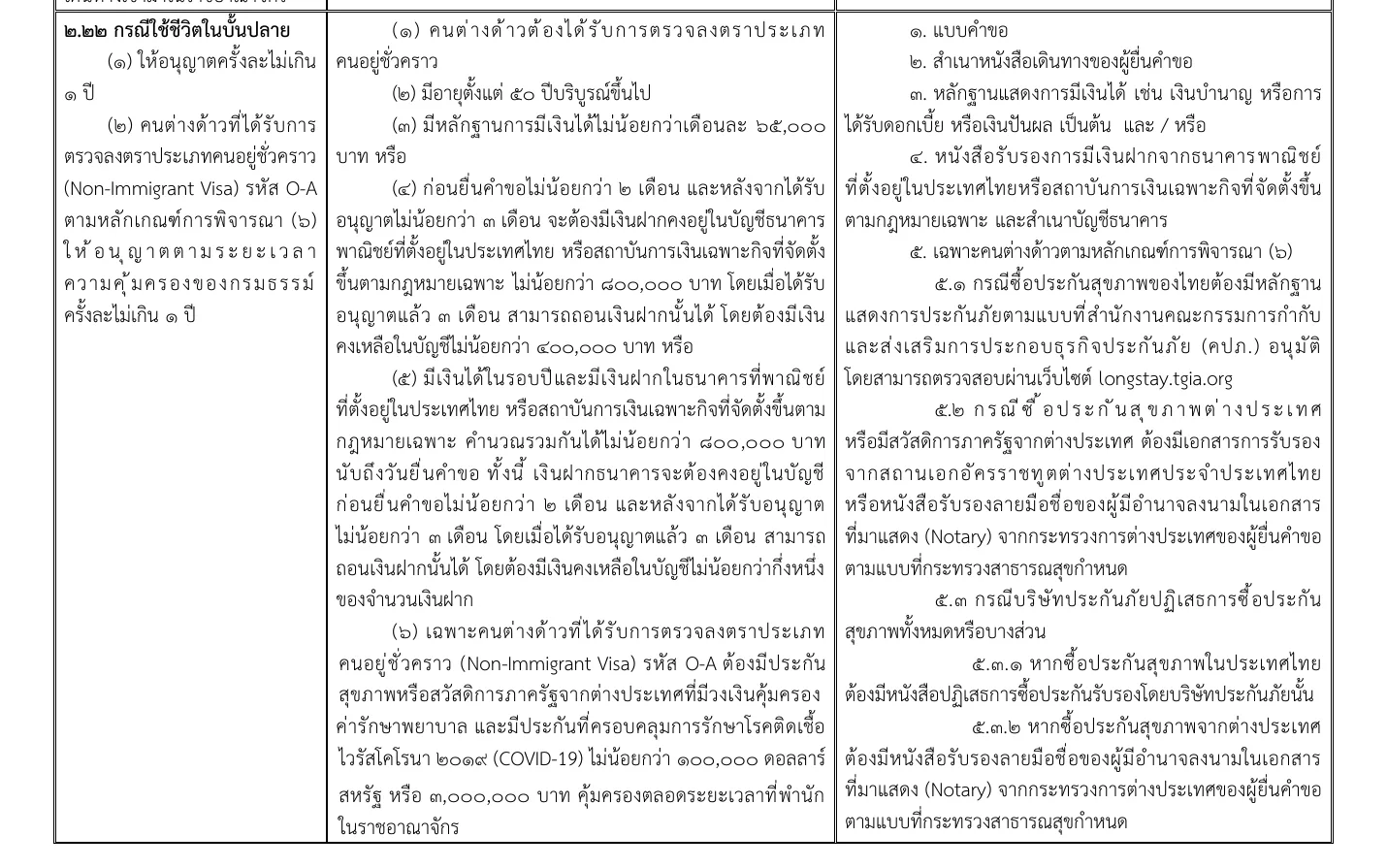
Start with the Non-O retirement extension if you are 50 or older and can show THB 800,000 in a Thai bank, or THB 65,000 a month. Only the O-A needs health insurance. The O-X asks for THB 3 million in a Thai bank.
On this page
If you are 50 or older and can show THB 800,000 in a Thai bank, start with the yearly Non-O retirement extension. It is the simplest route, and it is the only one of the long-stay options where you do not need health insurance.
The other routes below change the money test or the paperwork. Under 50, see the DTV guide instead.
Which retirement route fits you
| Route | Age | Money test | Health insurance | Stay |
|---|---|---|---|---|
| Non-O, then yearly extension | 50 | THB 800,000, or THB 65,000 a month, or both combined to THB 800,000 | O-A holders only | 1 year at a time |
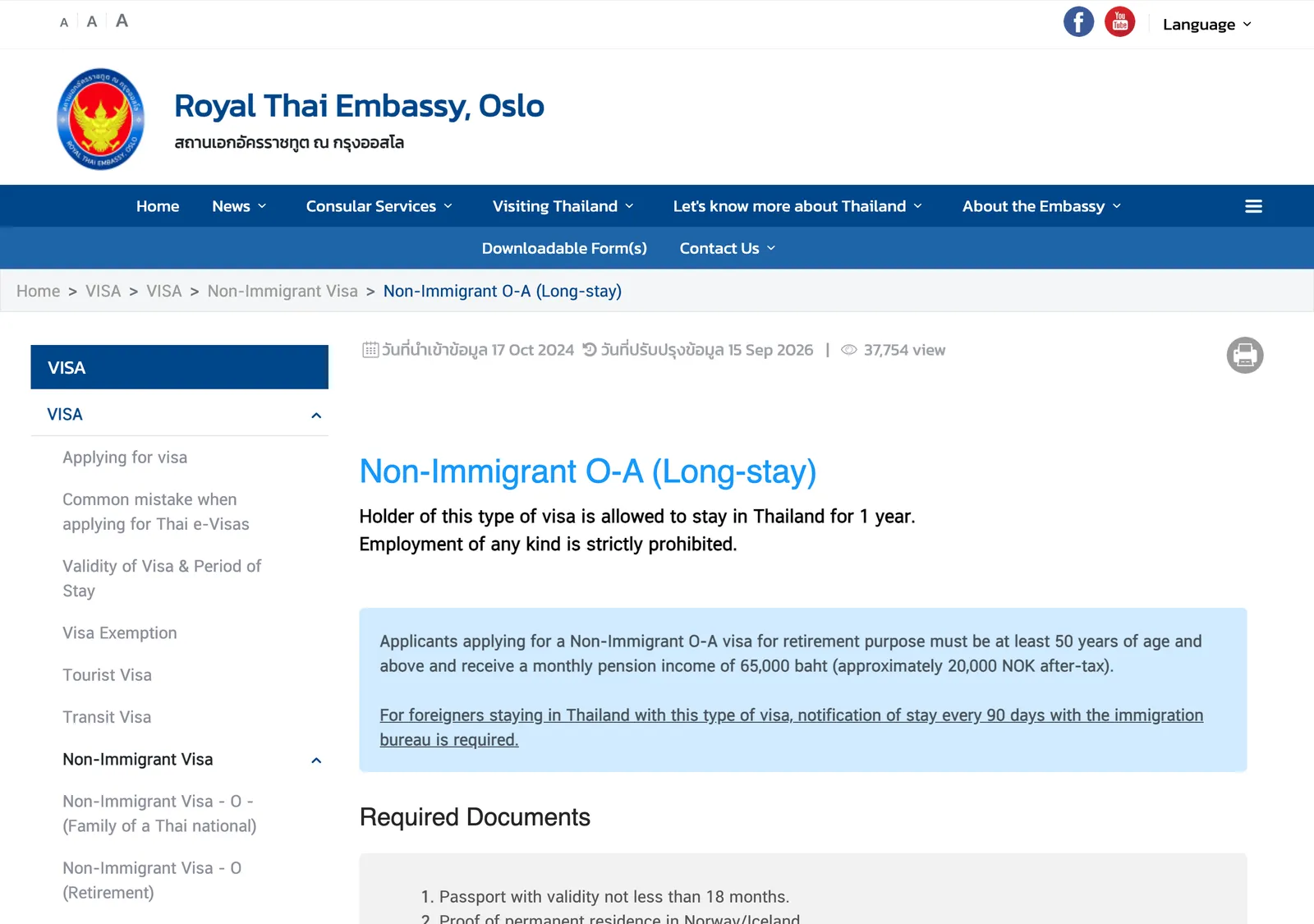
| O-A from an embassy | 50 | THB 800,000 statement, or THB 65,000 monthly pension | USD 100,000 or THB 3,000,000 | 1 year |
| O-X from an embassy | 50 | THB 3 million, or THB 1.8 million plus THB 1.2 million a year | Outpatient THB 40,000, inpatient THB 400,000 | Up to 10 years |
| LTR Wealthy Pensioner | 50, retired | Pension or fixed income of USD 80,000 a year | USD 50,000 | 5 years, extendable by 5 |
| Privilege membership | none | Membership fee from THB 650,000 | Not mandatory | 5 years on Bronze |
Our pick depends on what you hold. A Thai bank deposit points to the Non-O extension. A passport from a listed country plus THB 3 million points to the O-X. A pension of USD 80,000 a year points to the LTR.
A fee and no income test is Privilege, and the retirement visa comparison has the full document lists.
The Non-O and the yearly extension
You enter on a Non-Immigrant O for retirement, which gives 90 days on entry and asks for an age of at least 50. Inside Thailand, a one-year extension may then be granted at the officer’s discretion if you meet the requirements. Pick one money test:
- Income: evidence of at least THB 65,000 a month.
- Deposit: at least THB 800,000 in a Thai bank.
- Combined: income during the year plus a Thai bank deposit totalling at least THB 800,000 on the filing date.
On the deposit route the money must sit in the account at least 2 months before filing and at least 3 months after permission is granted. After that you can withdraw, but at least THB 400,000 must remain. On the combined route at least half of the deposit amount must stay.
You file at the immigration office covering where you live; in Bangkok that is the Chaeng Watthana office. Bring the TM.7 form and a copy of your passport, plus a bank certificate of deposit and a copy of the account if you use the deposit route. An extension of stay costs THB 1,900, and permission is granted for no more than 1 year at a time.
O-A, O-X, LTR and Privilege
O-A. You get it from an embassy, it lets you stay 1 year, and you show a bank statement of not less than THB 800,000 or a monthly pension income of 65,000 baht. Insurance is coverage of not less than USD 100,000 or THB 3,000,000, including COVID-19, for the whole stay. Employment of any kind is strictly prohibited.
O-X. This is the 10-year route: up to 10 years with multiple entries, available only to listed nationalities. You deposit THB 3 million in a Thai bank, or THB 1.8 million plus income of THB 1.2 million a year. The permit may be revoked if the account holds less than THB 3 million at the end of the first year. O-X holders may work as volunteers, buy a vehicle and buy a condominium under the Condominium Act, but employment of any kind is strictly prohibited.
LTR Wealthy Pensioner. You must be 50 or over and retired at the time of application. The tests are pensions or fixed income of at least USD 80,000 a year, or between USD 40,000 and 80,000 a year plus at least USD 250,000 invested in Thailand. The visa lasts 5 years, extendable by 5, and costs THB 50,000 for the 10-year multiple-entry version when collected in Thailand. The LTR visa guide has the rest.
Privilege membership. Bronze is THB 650,000 for 5 years and Gold is THB 900,000 for 5 years. Membership grants long-term visa status only, not the right to work, and gives no tax advantages. See the Privilege price guide.
Married to a Thai? The family extension has a lower bar: income of at least THB 40,000 a month, or at least THB 400,000 in a Thai bank for the past 2 months. See the marriage visa guide.
What you do every year
Do these in this order, and each has its own page.
- Extend your stay before permission ends.
- Report your address every 90 days. Report from 15 days before to 7 days after the due date. A late report is settled by a THB 2,000 fine.
- Buy a re-entry permit before every trip out. A single permit costs THB 1,000 and a multiple one costs THB 3,800. Leave without one and your permission to stay is considered terminated.
- Ask your landlord about the TM.30. The fine for failing is up to two thousand baht.
- On the O-X, report in person every year. An LTR holder reports once a year instead of every 90 days and is exempt from re-entry permits.
Overstaying is a separate problem: the fine is THB 500 per day, up to a maximum of THB 20,000. For details read the address report guide, the re-entry permit guide and the landlord notice guide.
Money: banks and tax
The deposit routes need a Thai bank account, and that is where many retirees get stuck. Kasikornbank asks foreigners for a passport and a non-immigrant visa of any type, and it does not open accounts for holders of tourist visas, including the Destination Thailand Visa. Bangkok Bank opens accounts at any branch in Thailand, but you must go in person. Read the bank account guide before you go.
On tax, days decide: a stay of 180 days or more in a tax year makes you a resident for that year. Foreign income earned from 1 January 2024 is taxed when you bring it into Thailand in that or a later year. In a year when you were in Thailand fewer than 180 days, that year’s foreign income is not taxed even if brought in. LTR Wealthy Pensioners are exempt from Thai tax on foreign income of a previous tax year that they bring in.
The tax residency guide has worked examples.
Healthcare
Private hospitals are of a high standard but can be expensive, and all hospitals require a guarantee of payment before treating patients. The national health security right starts with Thai nationality, so plan to carry private insurance. Call 1669 for a medical emergency. In Bangkok, Bumrungrad is one hospital that charges all nationalities the same price. See Bangkok international hospitals, the expat health insurance guide and hospital costs.
Buying and renting a home
Foreigners together may own no more than 49% of the total unit area of each condominium building. A foreigner may acquire land only under a treaty that gives the right to own immovable property, and Thailand has made no treaty of that kind since the earlier ones ended. That is why most retirees rent or take a lease; the Land Office does not register a lease longer than 30 years. See the condo quota guide.
If you rent, ask for the deposit terms in writing. Under the residential lease notice, advance rent and deposit together may not exceed three months of the monthly rent, and the deposit comes back within seven days if you caused no damage.
Where to live
Bangkok is covered on this site, Chiang Mai at chiangmaijao.com (opens in a new tab) and Phuket at phuketanchor.com (opens in a new tab). For a lower-end one-bedroom plus everyday costs for one adult, the example month is THB 31,100 in Bangkok, THB 20,250 in Chiang Mai and THB 25,750 in Phuket.
In Bangkok, one-bedroom rents start at THB 12,000 in On Nut and THB 22,000 in Sukhumvit. The Bangkok immigration counter handles the TM.30 and the 90-day notification. Read where to live in Bangkok, the city cost comparison, the Bangkok guide and the living hub.
Not confirmed: The exact insurance sum your embassy asks for on the O-A: older embassy pages still show a different split. Check the page of the post where you apply before you buy a policy.
Common questions
Can you withdraw the deposit once the extension is granted?
Three months after permission you can withdraw, but at least THB 400,000 must remain. On the combined route at least half of the deposit amount must remain.
Do you need health insurance for the retirement extension?
Only holders of the O-A visa need it. The cover is at least USD 100,000 or THB 3,000,000, including COVID-19, for the whole stay.
Which nationalities can get the O-X visa?
Australia, Denmark, Germany, Finland, France, Italy, Japan, Canada, the Netherlands, Norway, Sweden, Switzerland, the United States and the United Kingdom.
Can a retiree work in Thailand?
Employment of any kind is strictly prohibited on the O-A and the O-X. Privilege membership grants long-term visa status only, not the right to work.
Is a foreign pension taxed in Thailand?
Foreign-source income earned from 1 January 2024 is taxed when you remit it into Thailand. If you were in Thailand fewer than 180 days in the tax year, that year's foreign-source income is not taxed even if brought in.
Can a foreigner use the national health security (gold card) right?
The first qualification for the national health security right is Thai nationality.
Can a foreigner buy land in Thailand?
A foreigner may acquire land only under a treaty that gives the right to own immovable property. Thailand has made no treaty of that kind since the earlier ones ended.
What happens if you leave Thailand without a re-entry permit?
Your permission to stay is considered terminated. A permit granted before you leave lets you continue the remaining period of your visa when you return.
Read next
Sources and reader comments
Official legal texts (Gazette, government portals):
- Immigration Bureau Order No. 12/2568 (23 Jan 2025), clauses 1-7 on pp. 1-2 (scanned) plus the criteria table (clause 2) and annexes A-C on pp. 3-30; copy hosted by Chiang Rai Immigration (uploaded 2025-03-05); pdf pages 1-2 are images, read by eye (opens in a new tab)
- Immigration Division, Phitsanulok Provincial Immigration (immigration.go.th subdomain), O5 public service handbook (English part, extension criteria incl. retirement; machine-translated wording) (opens in a new tab)
- Royal Thai Embassy Oslo, Non-Immigrant Visa O-X (Long Stay 10 years) page (opens in a new tab)
- Royal Thai Consulate-General Chicago, Non-Immigrant Long Stay Visa (O-A)/(O-X) page (updated 22 Sep 2023) (opens in a new tab)
- Royal Thai Embassy Oslo, Non-Immigrant O-A (Long-stay) page (updated 15 Sep 2026) (opens in a new tab)
Show 31 more sources
- Thailand Privilege Card Co., Ltd. (state enterprise, sole shareholder the Tourism Authority of Thailand): Thailand Privilege Card vs Long-Term Resident Visa (opens in a new tab)
- Revenue Department (English) - Guide to Personal Income Tax Return 2024 (PND.90) (opens in a new tab)
- Q&A คำสั่งกรมสรรพากร ที่ ป.161 และ ป.162 — Revenue Department (กองกฎหมาย) (opens in a new tab)
- NHSO news page "สิทธิหลักประกันสุขภาพแห่งชาติของคนไทย" (10 Jun 2022). Read via Wayback copy. (opens in a new tab)
- Department of Lands, Acquisition of Land by Alien (English page, Wayback capture 4 Aug 2025) (opens in a new tab)
- Immigration Division 1 (Bangkok), English page: Re-entry Permit (archived 8 Aug 2024) (opens in a new tab)
- Office of the Board of Investment Announcement No. Por. 3/2568 (4 Feb 2025), English text marked Unofficial Translation, hosted on ltr.boi.go.th (opens in a new tab)
- Thailand BOI, LTR Visa Thailand - Long Term Resident Program (ltr.boi.go.th) (opens in a new tab)
- Thailand Privilege Card Co., Ltd. (state enterprise, sole shareholder the Tourism Authority of Thailand): Visa Membership price list (opens in a new tab)
- Royal Thai Embassy Oslo, Non-Immigrant O (Retirement) page (opens in a new tab)
- Royal Thai Embassy Phnom Penh, Non-Immigrant O Visa (Retirement) page (opens in a new tab)
- Immigration Bureau Public Handbook 2.4: extension of stay, tourism purpose (hosted on chiangmai.immigration.go.th O8 page; published 8 Nov 2019) (opens in a new tab)
- Immigration Division 1 Bangkok (immigration.go.th subdomain), Fee page, Wayback Machine snapshot of 2024-08-09 (live page blocks automated fetch) (opens in a new tab)
- Phitsanulok Immigration (ตม.จว.พิษณุโลก): procedure for notifying a stay over 90 days (TM.47), posted 27 Dec 2024 (opens in a new tab)
- Immigration Division 1 (Bangkok): fee schedule, Ministerial Regulation No. 27 (B.E. 2546) (archived 23 Jun 2024) (opens in a new tab)
- Phitsanulok Immigration: procedure for notifying foreigner residence (TM.30) for premises, posted 24 Dec 2024 (opens in a new tab)
- Chiang Mai Immigration: news item on hosts fined for not notifying within 24 hours (10-11 Jul 2023) (opens in a new tab)
- Immigration Division 1 (Bangkok), English FAQ page: overstay fine and bans (archived 8 Aug 2024) (opens in a new tab)
- Royal Decree issued under the Revenue Code (No. 743) B.E. 2565 (2022), Royal Gazette Vol. 139 Part 32 A, 23 May 2022, pp. 29-32 (Thai text hosted on ltr.boi.go.th) (opens in a new tab)
- GOV.UK (FCDO) Thailand travel advice: Health (opens in a new tab)
- National Institute for Emergency Medicine (niems.go.th), home page, Wayback snapshot of 2 Apr 2026 (opens in a new tab)
- พระราชบัญญัติอาคารชุด พ.ศ. ๒๕๒๒ (ฉบับสำนักงานคณะกรรมการกฤษฎีกา) — Department of Lands (opens in a new tab)
- 235 การจดทะเบียนเช่า — Department of Lands manual (registering a lease) (opens in a new tab)
- Royal Gazette vol. 142 special part 211 Ngor, pp. 80-84 (6 Jun 2025): Contract Committee notice making residential building rental a contract-controlled business B.E. 2568, with standard contract forms (copy hosted by OCPB) (opens in a new tab)
- Immigration Division 1 Bangkok: announcement of 10 Apr 2022 on the Muang Thong Thani centre closing and counters relocating (Wayback copy) (opens in a new tab)
Company and press pages (not official sources):
- Open Bank Account (savings) — Kasikornbank (opens in a new tab)
- Bangkok Bank: Foreign Customers FAQs (opens in a new tab)
- Bumrungrad Hospital: FAQ, are treatment costs different for local and international patients (bumrungrad.com) (opens in a new tab)
- AffordWhere: cost of living in Bangkok 2026 (rent aggregator and calculator; page says data last updated January 2026) (opens in a new tab)
- AffordWhere: cost of living in Chiang Mai 2026 (rent aggregator and calculator; page says data last updated January 2026) (opens in a new tab)
- AffordWhere: cost of living in Phuket 2026 (rent aggregator and calculator; page says data last updated January 2026) (opens in a new tab)
General information checked against the sources listed above. Prices, opening hours and other details change; confirm them with the provider before you act. See how guides are checked.
Spotted an error? Report it.