
Digital Nomad in Thailand: DTV, Tax, Insurance and Where to Base
The DTV is valid for 5 years and allows 180 days per entry, with financial evidence of no less than THB 500,000. Staying 180 days in a tax year makes you a Thai tax resident. Foreign income earned from 2024 is then taxed when you bring it into Thailand.
On this page
If you’re a remote worker planning a few months in Thailand, get the DTV: it lasts 5 years and gives you 180 days per entry, with no tourist-stay limits to juggle. You show financial evidence of no less than THB 500,000 at some posts, and the tax line sits at 180 days a year.
Which visa fits you
For a stay of up to 30 days, visa exemption is enough. For months of remote work, the DTV covers remote workers and freelancers. If you’re employed abroad by a listed company and earn USD 80,000 a year, LTR Work-from-Thailand is the heavier-duty option. A Thai employer hiring you needs a work permit, which starts with entry on a Non-Immigrant visa.
| Visa | Stay | Cost | What you show |
|---|---|---|---|
| DTV | 180 days per entry, valid 5 years | USD 400 Washington, GBP 300 London | Financial evidence of no less than THB 500,000 |
| Visa exemption | Up to 30 days, tourism only | Extension THB 1,900 | Proof of accommodation and onward travel |
| LTR Work-from-Thailand | Renewable 10 years: 5 plus 5 | THB 50,000 if collected in Thailand | Income of USD 80,000 a year |
Visa exemption is a tourist stay only, so it doesn’t suit remote work. The visa exemption guide has the rules.
The DTV
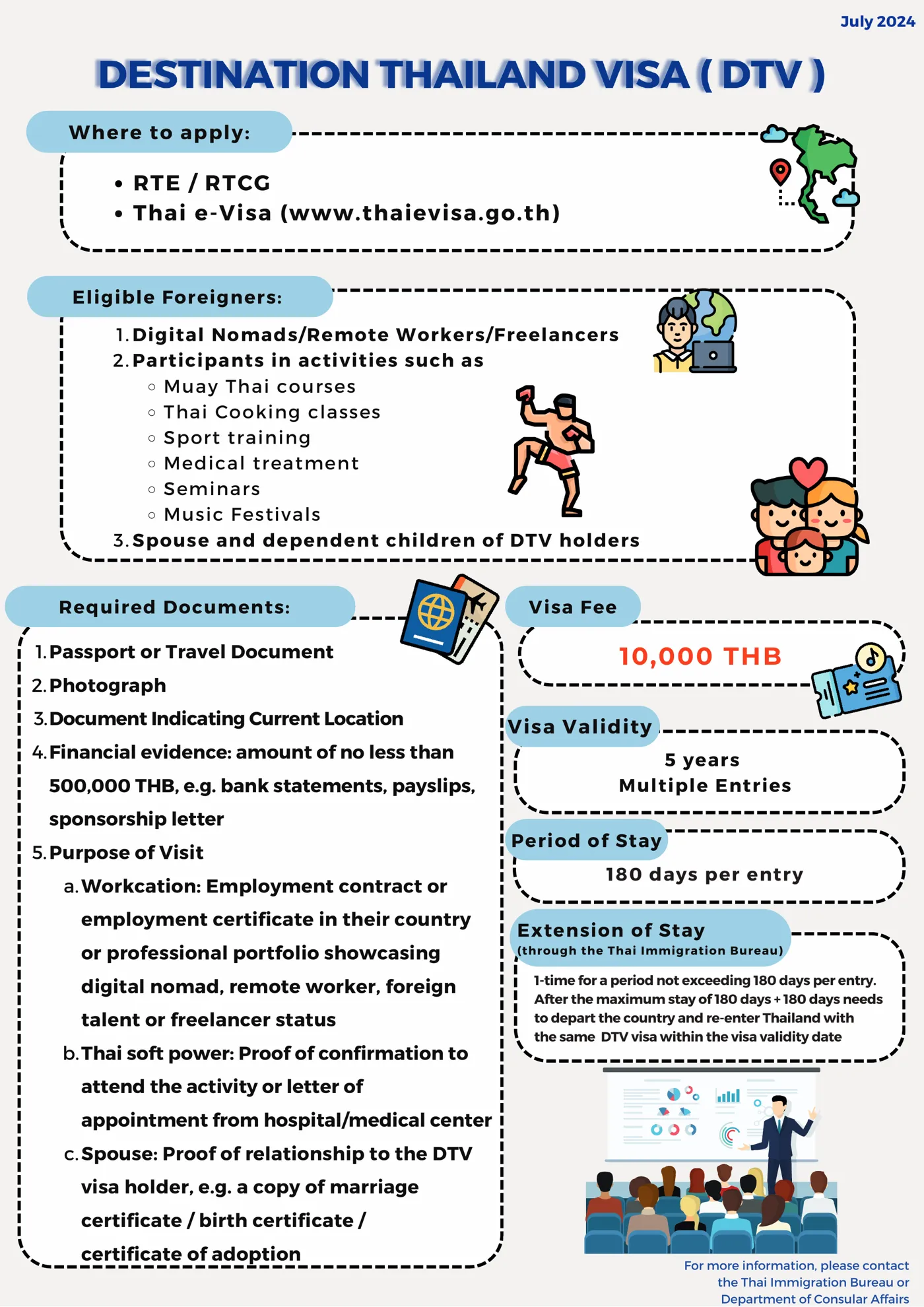
You apply on the Thai e-Visa platform or at a Royal Thai Embassy or Consulate-General. For remote work you show an employment contract, an employment certificate or a professional portfolio. The funds proof differs by post: Washington D.C. wants bank statements for the last three months ending at no less than THB 500,000, and London wants financial evidence of no less than GBP 12,000. Applications submitted from 31 August 2026 also need proof of permanent residence and a criminal record clearance certificate.
One extension of up to 180 days goes through the Immigration Bureau, and the general fee for an extension of stay is THB 1,900 (as of August 2024). After that you leave and re-enter on the same DTV. Visa fees are non-refundable. The DTV guide has the document lists by post.
Can you work from Thailand?
Not for Thai clients. Embassy guidance on the DTV prohibits freelance work for Thai clients and work for companies in Thailand. No foreigner may work without a work permit, and breaking that rule brings a fine of THB 5,000 to THB 50,000 and removal from the Kingdom.
LTR Work-from-Thailand holders can’t work for Thai employers or earn income in Thailand either. Remote work for a foreign employer is covered in the Not confirmed box above. The work permit guide covers the Thai-employer route.
Tax: the 180-day line
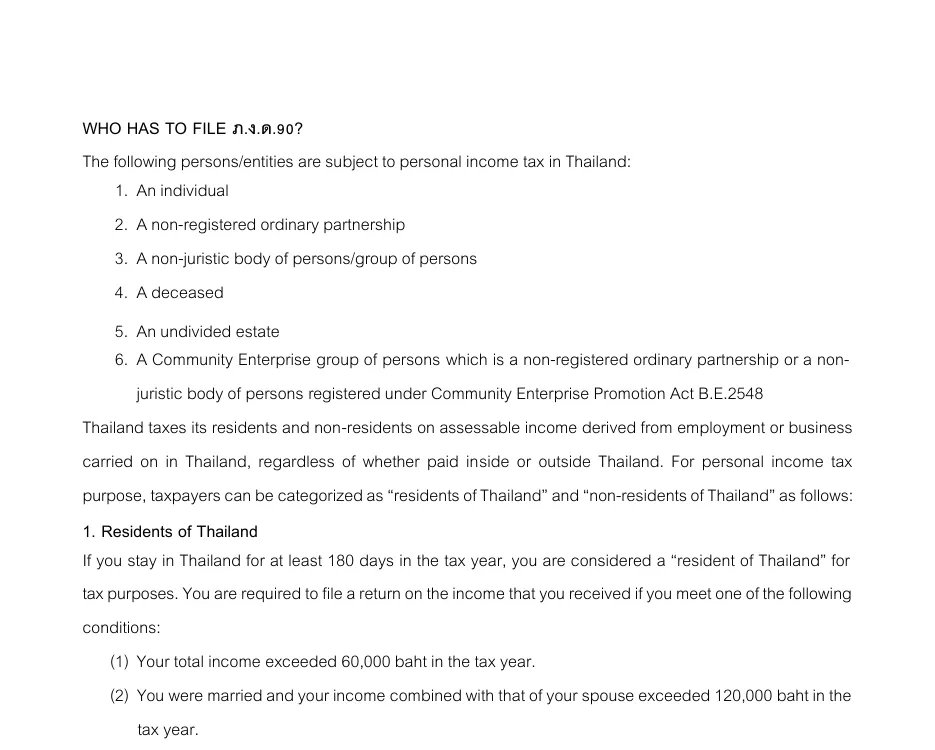
Stay 180 days or more between 1 January and 31 December, in one stay or several, and you’re a Thai tax resident for that year. Nationality doesn’t matter. With 179 days you’re not a resident that year.
Foreign income is assessable when you’re resident and you remit it into Thailand. This covers income earned from 1 January 2024. With fewer than 180 days in the tax year, foreign income of that year isn’t taxed even if you bring it in.
Income from work done in Thailand is taxable in Thailand whether it’s paid inside or outside the country. A resident can credit tax paid abroad under a double tax agreement. A resident files if total income in the tax year exceeded THB 60,000. Rates start with the first THB 150,000 exempt and 5% on the next slice.
The full rules are in the remote worker tax guide and the tax residency guide.
Reporting and the arrival card
If you stay over 90 days you report your residence every 90 days. You can report from 15 days before to 7 days after the due date. A late report is made in person and settled by a THB 2,000 fine. See the report guide.
Your landlord files the TM.30 within 24 hours of you taking up residence; a host who doesn’t faces a fine of up to THB 2,000. The TM30 guide explains it. Before you fly, complete the free TDAC online within 3 days before arrival. An overstay costs THB 500 per day, capped at THB 20,000; the overstay guide has the cases.
Insurance
All hospitals in Thailand require a guarantee of payment before treating patients, so get cover before you arrive. More in the expat health insurance guide and hospital costs.
Banking, SIM and where to base
On a DTV, opening a Thai bank account runs into each bank’s own rule: KBank doesn’t open accounts for holders of tourist or other travel-type visas, including the DTV. Start with the open a bank account guide, then banking apps and PromptPay and ATM fees. A tourist SIM won’t last a long stay, so see the eSIM options.
For where to live, Chiang Mai has the lowest example month for one adult at THB 20,250, against THB 31,100 in Bangkok. Costs by city are on the cost of living page.
- Bangkok: where to live, cost of living and the city guide.
- Chiang Mai: the overview here, and the full guide at Chiang Mai Jao (opens in a new tab).
- Phuket: the overview here, and the full guide at Phuket Anchor (opens in a new tab).
- Koh Samui, Koh Phangan and Koh Tao: the islands guide.
Not confirmed: Whether remote work for a foreign employer needs a Thai work permit: no official text found, so ask the Department of Employment before you start. Whether pay for days worked in Thailand counts as Thai income: no ruling found, so ask the Revenue Department on 1161. The DTV extension fee: no official text names it.
Common questions
Which visa is best for a digital nomad in Thailand?
The DTV covers digital nomads, remote workers and freelancers. It is valid for 5 years with 180 days per entry. Visa-exempt entry is for tourism only, for up to 30 days.
Do you pay Thai tax on foreign income?
Foreign income is assessable when you are resident, meaning 180 days or more in the year, and you remit it into Thailand. The rule covers income earned from 1 January 2024. With fewer than 180 days, foreign income of that year is not taxed even if you bring it in.
Can you work for a Thai client on a DTV?
Embassy guidance on the DTV prohibits freelance work for Thai clients and work for companies in Thailand. Working without a permit risks a fine of THB 5,000 to THB 50,000 and removal from the Kingdom.
Can a DTV holder open a Thai bank account?
KBank does not open accounts for holders of tourist or other travel-type visas, including the DTV.
Do you report to immigration every 90 days?
Anyone permitted a temporary stay who stays over 90 days must report their residence every 90 days. You may report from 15 days before to 7 days after the due date.
Read next
Sources and reader comments
Official legal texts (Gazette, government portals):
- Royal Thai Embassy London, Destination Thailand Visa page (updated 8 Sep 2026) (opens in a new tab)
- Q&A คำสั่งกรมสรรพากร ที่ ป.161 และ ป.162 — Revenue Department (กองกฎหมาย) (opens in a new tab)
- Royal Thai Embassy Washington D.C., Destination Thailand Visa (DTV) page (updated 10 Sep 2026) (opens in a new tab)
- ประมวลรัษฎากร หมวด 3 ภาษีเงินได้ มาตรา 38-64 — Revenue Department (rd.go.th) (opens in a new tab)
- Revenue Department: Manual for Foreign Tax Credit Calculation Tool (Personal Income Tax), November 2025 (opens in a new tab)
Show 26 more sources
- Ministry of Foreign Affairs of Thailand, DTV infographic (July 2024) (opens in a new tab)
- Royal Thai Embassy, London: Visa Exemption and Visa on Arrival Schemes (effective 15 Sep 2026) (opens in a new tab)
- Royal Thai Embassy, Budapest — Destination Thailand Visa (DTV) page (opens in a new tab)
- พระราชกำหนดการบริหารจัดการการทำงานของคนต่างด้าว (ฉบับที่ ๒) พ.ศ. ๒๕๖๑ — Royal Gazette vol. 135 part 19 ก, 27 March 2018 (copy hosted by the Department of Employment) (opens in a new tab)
- Ministry of Labour (English news), Labour Minister emphasizes Trai Thep Phithak task force crackdown, posted 15 May 2025 (opens in a new tab)
- Phitsanulok Immigration (ตม.จว.พิษณุโลก): procedure for notifying a stay over 90 days (TM.47), posted 27 Dec 2024 (opens in a new tab)
- Office of the Board of Investment Announcement No. Por. 3/2568 (4 Feb 2025), English text marked Unofficial Translation, hosted on ltr.boi.go.th (opens in a new tab)
- Department of Employment, public service handbook no. 1: new work permit for a Non-Immigrant doing work that needs knowledge or skill, Section 59 (Thai) (opens in a new tab)
- Immigration Division 1 Bangkok (immigration.go.th subdomain), Fee page, Wayback Machine snapshot of 2024-08-09 (live page blocks automated fetch) (opens in a new tab)
- Thailand BOI, LTR Visa Thailand - Long Term Resident Program (ltr.boi.go.th) (opens in a new tab)
- Royal Thai Embassy Moscow, Adjustment to Supporting Documents for DTV Applications (reproduces Department of Consular Affairs announcement of 28 Aug 2026) (opens in a new tab)
- Royal Thai Embassy Helsinki, DTV page (notice updated 26 Aug 2026) (opens in a new tab)
- Thailand Digital Arrival Card official site, Immigration Bureau (version 2026.10, read 17 Oct 2026) (opens in a new tab)
- Thailand BOI, LTR Visa FAQ (ltr.boi.go.th) (opens in a new tab)
- คำสั่งกรมสรรพากร ที่ ป.161/2566 (แก้ไขโดย ป.162/2566) — Revenue Department (opens in a new tab)
- Revenue Department (English) - Guide to Personal Income Tax Return 2024 (PND.90) (opens in a new tab)
- อัตราภาษีเงินได้บุคคลธรรมดาสำหรับปีภาษี 2560 (ยื่นปี 2561 เป็นต้นไป) — Revenue Department (rd.go.th) (opens in a new tab)
- Phitsanulok Immigration: procedure for notifying foreigner residence (TM.30) for premises, posted 24 Dec 2024 (opens in a new tab)
- Chiang Mai Immigration: news item on hosts fined for not notifying within 24 hours (10-11 Jul 2023) (opens in a new tab)
- Immigration Act B.E. 2522, consolidated Thai text with amendment footnotes (Phuket Immigration Office copy, last footnote 2018) (opens in a new tab)
- Royal Thai Embassy, London: Thailand Digital Arrival Card (TDAC) required from 1 May 2025 (opens in a new tab)
- Royal Thai Embassy, Washington D.C.: Advice on Thailand Visa Overstay Regulations (14 Sep 2023) (opens in a new tab)
- GOV.UK (FCDO) Thailand travel advice: Health (opens in a new tab)
Company and press pages (not official sources):
- Open Bank Account (savings) — Kasikornbank (opens in a new tab)
- AffordWhere: cost of living in Chiang Mai 2026 (rent aggregator and calculator; page says data last updated January 2026) (opens in a new tab)
- AffordWhere: cost of living in Bangkok 2026 (rent aggregator and calculator; page says data last updated January 2026) (opens in a new tab)
General information checked against the sources listed above. Prices, opening hours and other details change; confirm them with the provider before you act. See how guides are checked.
Spotted an error? Report it.